About an hour away from Argao is the quaint town of
Boljoon (pronounced “bul-ho-on”), which struck me at first sight as one of
Cebu’s picturesque coastal towns often depicted in postcards. Founded in 1598,
Boljoon lies on a coastal plain that's bordered by lush forests and limestone hills that provide an uninterrupted view of Bohol Strait.
 Dubbed by its drumbeaters as the “Heritage Frontier of
Cebu”, the idyllic town has several impressive landmarks worth exploring if you
have the luxury of time. For me, however, a heritage walk around the
awe-inspiring Boljoon Church would suffice.
Dubbed by its drumbeaters as the “Heritage Frontier of
Cebu”, the idyllic town has several impressive landmarks worth exploring if you
have the luxury of time. For me, however, a heritage walk around the
awe-inspiring Boljoon Church would suffice.
 |
The Rock of Ili in Boljoon
|

 When I first saw it a few months ago on a bus en route to
Negros Oriental, the plain-looking old church with a triangular pediment
bedecked with sparse reliefs standing prominently beside the national highway
hardly impressed me.
When I first saw it a few months ago on a bus en route to
Negros Oriental, the plain-looking old church with a triangular pediment
bedecked with sparse reliefs standing prominently beside the national highway
hardly impressed me.
Maybe I should skip this one, I initially thought while finalizing the
list of heritage churches that would form part of my impromptu visita iglesia. Good thing, I didn’t.
Appearances often are deceiving, so goes the cliché. This, I discovered to be
true in the case of the Boljoon Church.

 Named in honor of the town’s patroness, the Church of the Patronage of
Our Lady (Nuestra Señora Patrocinio de Maria), I discovered later, is
the only one in the whole province that’s been recognized as a National
Cultural Treasure by the National Museum of the Philippines in 2000!
Named in honor of the town’s patroness, the Church of the Patronage of
Our Lady (Nuestra Señora Patrocinio de Maria), I discovered later, is
the only one in the whole province that’s been recognized as a National
Cultural Treasure by the National Museum of the Philippines in 2000!

 A year earlier, the National Historical Institute had
also identified the church as a National Historical Landmark. To fully
appreciate why the country’s history and culture experts have bestowed such
honors to the Patrocinio de Maria Church, you have to explore its vast sacred
grounds.
A year earlier, the National Historical Institute had
also identified the church as a National Historical Landmark. To fully
appreciate why the country’s history and culture experts have bestowed such
honors to the Patrocinio de Maria Church, you have to explore its vast sacred
grounds.
Built by the Augustinians in 1783, the church is one of
the oldest surviving coral stone edifices in Cebu. Despite its age, it has
managed to survive a slew of Moro raids, typhoons, floods, and earthquakes. The existing
structure, however, isn’t the original one; it’s said to have been destroyed by
hostile Moro invaders.
 Twin cornice stone moldings divide the church’s façade
into three, with the pediment bearing a carved symbol of the Augustinians. The
second level is adorned with shallow pilasters with floral motifs and arch
windows flanking a niche containing a statue of the town’s patroness.
Underneath the icon is the Spanish coat-of-arms.
Twin cornice stone moldings divide the church’s façade
into three, with the pediment bearing a carved symbol of the Augustinians. The
second level is adorned with shallow pilasters with floral motifs and arch
windows flanking a niche containing a statue of the town’s patroness.
Underneath the icon is the Spanish coat-of-arms.

 At the lowest level are two reliefs flanking the
semi-circular portal. On the right is St. John of Sahagun with his right hand
carrying a chalice while on the left is St. Nicholas of Tolentine holding a
piece of bread and a palm. If I’m not mistaken, these symbolize Christ’s flesh
and blood.
At the lowest level are two reliefs flanking the
semi-circular portal. On the right is St. John of Sahagun with his right hand
carrying a chalice while on the left is St. Nicholas of Tolentine holding a
piece of bread and a palm. If I’m not mistaken, these symbolize Christ’s flesh
and blood.
It was, however, the bas-reliefs of a pelican feeding her
own flesh to her young, which I saw at the bases of the pilasters on my way to
the church’s interior that really caught my fancy as they bear profound
symbolisms of the Christian faith.

 An early Christian legend has it that in times of famine
or drought, the mother pelican would peck her own breast and feed her young
with her flesh and blood to keep them alive—even if such a selfless act would
actually mean her own death!
An early Christian legend has it that in times of famine
or drought, the mother pelican would peck her own breast and feed her young
with her flesh and blood to keep them alive—even if such a selfless act would
actually mean her own death!
 Looking at those reliefs carved on the church’s walls,
anyone can easily see why it has been used as a decorative motif in the Boljoon
Church and in many other houses of worship, I guess. In those images, the
pelican which sacrificed itself is a metaphor for Christ who gave his own life
for humanity’s sake.
Looking at those reliefs carved on the church’s walls,
anyone can easily see why it has been used as a decorative motif in the Boljoon
Church and in many other houses of worship, I guess. In those images, the
pelican which sacrificed itself is a metaphor for Christ who gave his own life
for humanity’s sake.

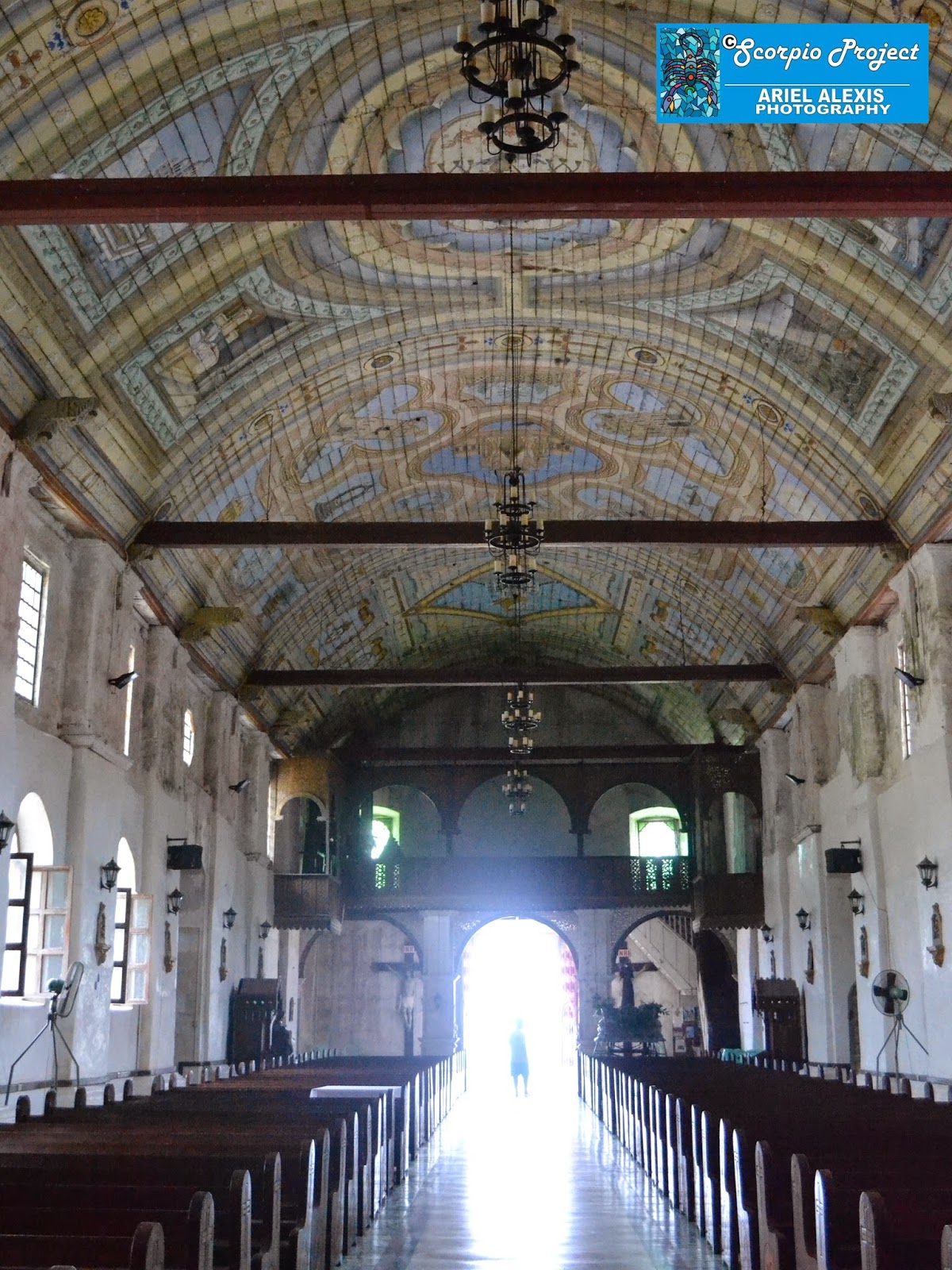
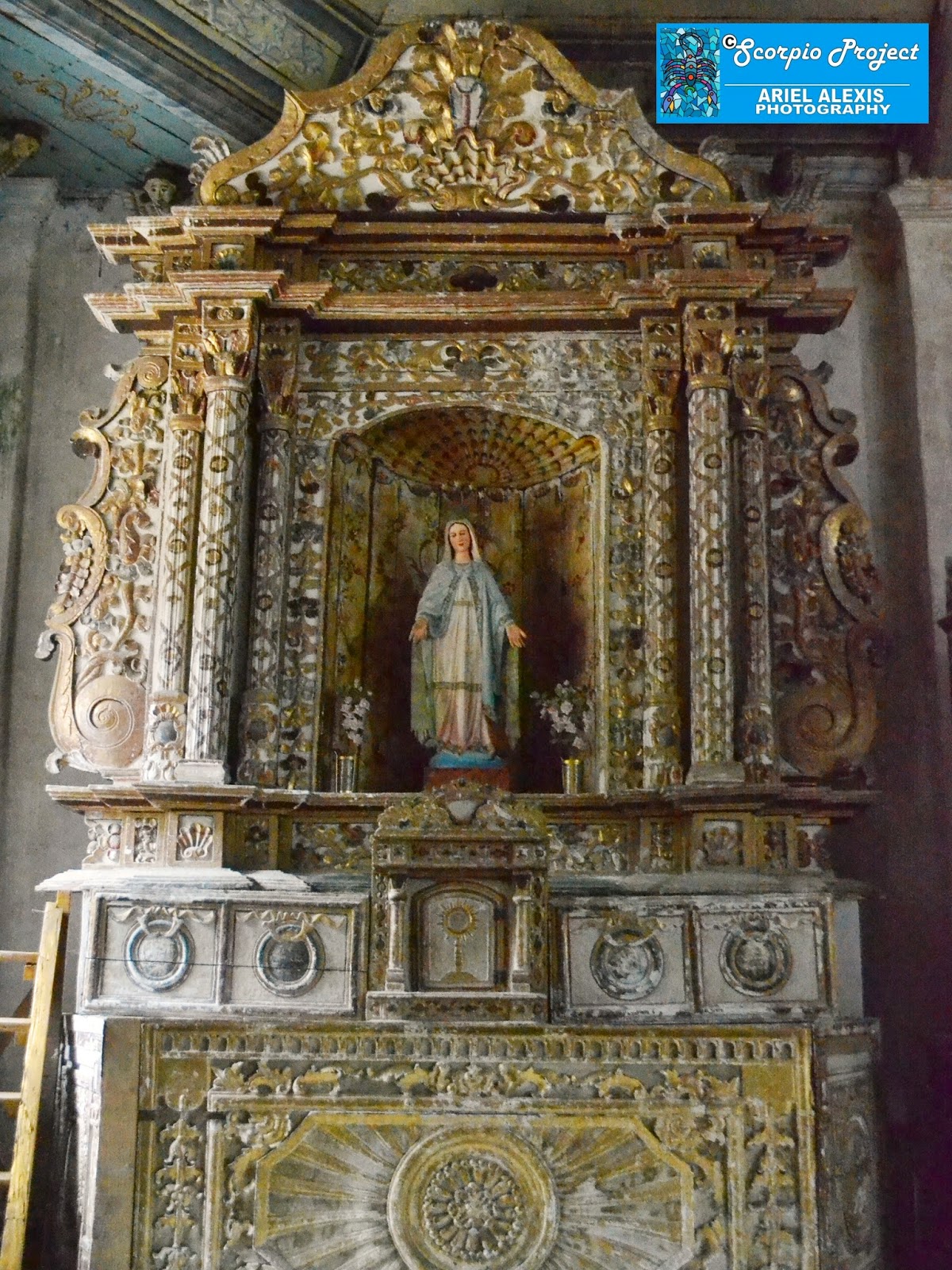
Inside the church, a treasure-trove of delightful
architectural surprises await visitors: a long nave whose grandness is matched
by a painted ceiling with artwork stretching along its entire length; an
exquisite wooden pulpit with carvings and three Rococo-Baroque niched retablos housing icons of venerated
saints.
 |
Interior of the Boljoon Church
|
Stretching from the choir loft all the way to the main retablo, the beautiful paintings on the
ceiling stunned me. Said to have been done by one of the town’s local artists,
Miguel Villareal (not Canuto Avila nor Ray Francia as I had earlier thought), the
paintings reminded me of the ones I saw in the churches of Argao, Carcar and
Dalaguete.
The main and two side retablos appeared to have been restored with a sprinkling of gold dust. Some portions of the structures, however, have not been covered by the dusting. Despite this, the old world charms of the church’s interior haven’t diminished a bit since the technique was painstakingly done with consistency.
 Viewing the church from the sanctuary, I noticed the
choir loft with intricately carved traceries on the railings. A pipe organ
that’s said to be second oldest in the country hangs on one corner of the church near the
choir loft.
Viewing the church from the sanctuary, I noticed the
choir loft with intricately carved traceries on the railings. A pipe organ
that’s said to be second oldest in the country hangs on one corner of the church near the
choir loft.
Facing Bohol Strait, the massive church stands proudly
like a sentinel on the lookout for intruders. It may be a house of worship but
it was built for defense—a fortress designed to protect the people against the
persistent Moro invasions of yore.
Structured like the quintessential “fortress Baroque”
church, Patrocinio de Maria was so designed for a purpose—to help quell the
spate of pernicious Moro slave raids that plagued many of Cebu’s coastal towns,
including Boljoon, during the 1820s. One just has to look at the archway leading to the church
to get an idea that it’s ever ready to wage a war to protect itself and its
parishioners. No less than a sculptor of the warrior angel himself—St.
Michael the Archangel—guards its entrance archway!
 Annoyed by the frequent invasions, Fray Julian Bermejo,
better known as "El Capitan Parroco", the intrepid warrior priest of Boljoon,
successfully convinced his fellow priests and the parishioners to build a chain
of fortifications that included bulwarks, fences and watchtowers, in the coastal
towns of the province.
Annoyed by the frequent invasions, Fray Julian Bermejo,
better known as "El Capitan Parroco", the intrepid warrior priest of Boljoon,
successfully convinced his fellow priests and the parishioners to build a chain
of fortifications that included bulwarks, fences and watchtowers, in the coastal
towns of the province.
 |
| Icon of St. Michael |
Known as baluarte in Spanish, the bulwarks had watchtowers (lantawan to the locals) doubling as belfries equipped not only with bells but also canons and tall poles
on which flags where hoisted to serve as early warning to the townspeople of any
forthcoming Moro attack, as in the case of Boljoon.
 Boljoon also has a rectory that’s probably the oldest and
biggest remaining residential building from Spanish colonial times. Located
beside the church, the two-story structure, which was completed in 1847, used
to accommodate the top members of the clergy who regularly came to town in
those days.
Boljoon also has a rectory that’s probably the oldest and
biggest remaining residential building from Spanish colonial times. Located
beside the church, the two-story structure, which was completed in 1847, used
to accommodate the top members of the clergy who regularly came to town in
those days.
 |
| Original marble tiles on the floor |
Formerly a bodega, the rectory's ground floor has been
converted into a museum showcasing the town's ecclesiastical and liturgical
treasures. Leading up to the second floor is a grand staircase with ornately
carved posts. The second floor currently houses the town’s parish priest and
his aides.
 |
| The rectory's grand staircase |
Recently, the rectory survived the killer quake last
October 2013 that struck Bohol, Cebu and other nearby places, destroying many
old structures. I noticed, however, that huge orange tarpaulins have been
placed on its roof, which is made of clay roof tiles. Maybe they’re covering
the damaged parts of the roof, I surmised.
 Indeed, paying a visit to the Boljoon Church will make
any true-blue Pinoy proud of his heritage. And it won’t come as a surprise to
me if the Patrocinio de Maria Church would be among those that will make it to
the next batch of the country’s Baroque churches to be included in the list of
UNESCO World Heritage Sites.
Indeed, paying a visit to the Boljoon Church will make
any true-blue Pinoy proud of his heritage. And it won’t come as a surprise to
me if the Patrocinio de Maria Church would be among those that will make it to
the next batch of the country’s Baroque churches to be included in the list of
UNESCO World Heritage Sites.
(to be continued)
In coming up with
this anthology on Cebu’s heritage churches, I’ve referred to the following:

 Scale
new heights, swim in turquoise waters and scamper to a new place I’ve never
been were among the things I wanted to do as summer began. So far, I was
able to push through with the last two summer goals last March and April,
respectively, except for the first one. Some unfounded fear kept me from pursuing
it. I haven’t scaled a peak the past three years, and that, I believe, has
created a deep hole of doubt in me—so deep I dreamed about dying during a trek!
Scale
new heights, swim in turquoise waters and scamper to a new place I’ve never
been were among the things I wanted to do as summer began. So far, I was
able to push through with the last two summer goals last March and April,
respectively, except for the first one. Some unfounded fear kept me from pursuing
it. I haven’t scaled a peak the past three years, and that, I believe, has
created a deep hole of doubt in me—so deep I dreamed about dying during a trek!


 Chances are, the Chocolate Hills of Bohol would most likely cross your mind the moment you lay eyes on the Mantalongon mountain range. The hills in the latter, however, are thinner, sharper and craggier. Unlike the Chocolate Hills, the peaks of the Mantalongon range are assembled near each other. I surmised that they must have been huge corals that rose up so high from under the sea millions of years ago.
  Why
do I like scaling peaks and mountains? Well, there’s something about them
that’s worth all the effort. To borrow the words of John Muir, Scottish-American
author and environmental philosopher: “Keep close to Nature's heart... and
break clear away, once in a while, and climb a mountain or spend a week in the
woods. Wash your spirit clean.” And climb Osmeña Peak I did “to wash my spirit
clean”. I guess I needed some “washing” if only to scrub out self-doubt.
Why
do I like scaling peaks and mountains? Well, there’s something about them
that’s worth all the effort. To borrow the words of John Muir, Scottish-American
author and environmental philosopher: “Keep close to Nature's heart... and
break clear away, once in a while, and climb a mountain or spend a week in the
woods. Wash your spirit clean.” And climb Osmeña Peak I did “to wash my spirit
clean”. I guess I needed some “washing” if only to scrub out self-doubt. It
was a hot Saturday when I finally embarked on my trek. Waking up early, I took
a quick shower, skipped breakfast and messaged Grab for a cab. Around 7 AM, I
was on my way to Cebu South Terminal. Arriving there, I was dismayed to see several
long queues waiting for the buses that will take them to various destinations.
On weekends, the terminal is usually packed with passengers going home to the
southern towns of Cebu and even to those in nearby Negros Island.
It
was a hot Saturday when I finally embarked on my trek. Waking up early, I took
a quick shower, skipped breakfast and messaged Grab for a cab. Around 7 AM, I
was on my way to Cebu South Terminal. Arriving there, I was dismayed to see several
long queues waiting for the buses that will take them to various destinations.
On weekends, the terminal is usually packed with passengers going home to the
southern towns of Cebu and even to those in nearby Negros Island. 
 Ignoring
the grumblings of my tummy, I decided to head straight for my ultimate
destination instead of having lunch first. I bought some stuff though from a
7-Eleven outlet at the town’s junction, intending to eat them later when I’m
already at the mountain’s summit. To get to the peak, I hired a motorcycle taxi
locally known as habal-habal, plying
the route from downtown Dalaguete to the upland village of Mantalongon, the
jump-off point for the peak.
Ignoring
the grumblings of my tummy, I decided to head straight for my ultimate
destination instead of having lunch first. I bought some stuff though from a
7-Eleven outlet at the town’s junction, intending to eat them later when I’m
already at the mountain’s summit. To get to the peak, I hired a motorcycle taxi
locally known as habal-habal, plying
the route from downtown Dalaguete to the upland village of Mantalongon, the
jump-off point for the peak.
 The
smooth ride along the zigzagging but well-paved Dalaguete-Badian Road passing
through Mantalongon treated me to a picturesque montage of the countryside—lush
mountains, rolling hills, steep cliffs, green veggie patches, quaint little huts
and charming rest houses and a whole lot more. About 45 minutes later, we
reached the base or jump-off point where visitors—I was among the throngs who
were mostly backpackers and hikers from Luzon—are made to sign at the Osmeña
Peak Tourism Center. Entrance fee is Php30 per person.
The
smooth ride along the zigzagging but well-paved Dalaguete-Badian Road passing
through Mantalongon treated me to a picturesque montage of the countryside—lush
mountains, rolling hills, steep cliffs, green veggie patches, quaint little huts
and charming rest houses and a whole lot more. About 45 minutes later, we
reached the base or jump-off point where visitors—I was among the throngs who
were mostly backpackers and hikers from Luzon—are made to sign at the Osmeña
Peak Tourism Center. Entrance fee is Php30 per person. Local guides often approach visitors, offering to show you the way to the peak for a fee, of course. It wouldn’t hurt your pocket to give something to augment the income of the locals, most of whom seem to live below the poverty line. I got the services of an older guide named Boy. About Php150 would suffice as guide’s fee but I gave him Php200 because he also doubled as porter and photographer.
 On
our way to the top, Boy told me that the peak was discovered by no less than
President Sergio Osmeña, Sr., the country's third president. Osmeña, a native
of Cebu, often had his plane landed there. Boy also mentioned that the boulder
where I posed for some pictures used to be a cornerstone bearing an inscription
about the late president’s discovery of the peak. I'm not sure though how
accurate his account was. Nonetheless, I enjoyed to the hilt that quick escape
to one of Cebu's highest points.
On
our way to the top, Boy told me that the peak was discovered by no less than
President Sergio Osmeña, Sr., the country's third president. Osmeña, a native
of Cebu, often had his plane landed there. Boy also mentioned that the boulder
where I posed for some pictures used to be a cornerstone bearing an inscription
about the late president’s discovery of the peak. I'm not sure though how
accurate his account was. Nonetheless, I enjoyed to the hilt that quick escape
to one of Cebu's highest points. If there’s one important
thing I gained from my trek to Osmeña Peak, it is this: That somewhere between
my soul and that highland hideaway, after all the starts and stops, the doubts
and the drifts, the sunburn, the sweat and thirst, swollen feet, sore muscles
and all, I’ve proven to myself that I still got what it takes to scale new
heights (although not as high as the other ones I’ve trekked before) and
stumbled upon a little bit of bliss up there where the sun kisses the jagged
hills. John Muir was right. We all need some “washing of the spirit” if only to
become bigger, better and bolder versions of our old selves. 🤣🤣🤣
If there’s one important
thing I gained from my trek to Osmeña Peak, it is this: That somewhere between
my soul and that highland hideaway, after all the starts and stops, the doubts
and the drifts, the sunburn, the sweat and thirst, swollen feet, sore muscles
and all, I’ve proven to myself that I still got what it takes to scale new
heights (although not as high as the other ones I’ve trekked before) and
stumbled upon a little bit of bliss up there where the sun kisses the jagged
hills. John Muir was right. We all need some “washing of the spirit” if only to
become bigger, better and bolder versions of our old selves. 🤣🤣🤣


 Why
do I like scaling peaks and mountains? Well, there’s something about them
that’s worth all the effort. To borrow the words of John Muir, Scottish-American
author and environmental philosopher: “Keep close to Nature's heart... and
break clear away, once in a while, and climb a mountain or spend a week in the
woods. Wash your spirit clean.” And climb Osmeña Peak I did “to wash my spirit
clean”. I guess I needed some “washing” if only to scrub out self-doubt.
Why
do I like scaling peaks and mountains? Well, there’s something about them
that’s worth all the effort. To borrow the words of John Muir, Scottish-American
author and environmental philosopher: “Keep close to Nature's heart... and
break clear away, once in a while, and climb a mountain or spend a week in the
woods. Wash your spirit clean.” And climb Osmeña Peak I did “to wash my spirit
clean”. I guess I needed some “washing” if only to scrub out self-doubt.


 Ignoring
the grumblings of my tummy, I decided to head straight for my ultimate
destination instead of having lunch first. I bought some stuff though from a
7-Eleven outlet at the town’s junction, intending to eat them later when I’m
already at the mountain’s summit. To get to the peak, I hired a motorcycle taxi
locally known as habal-habal, plying
the route from downtown Dalaguete to the upland village of Mantalongon, the
jump-off point for the peak.
Ignoring
the grumblings of my tummy, I decided to head straight for my ultimate
destination instead of having lunch first. I bought some stuff though from a
7-Eleven outlet at the town’s junction, intending to eat them later when I’m
already at the mountain’s summit. To get to the peak, I hired a motorcycle taxi
locally known as habal-habal, plying
the route from downtown Dalaguete to the upland village of Mantalongon, the
jump-off point for the peak.

 The
smooth ride along the zigzagging but well-paved Dalaguete-Badian Road passing
through Mantalongon treated me to a picturesque montage of the countryside—lush
mountains, rolling hills, steep cliffs, green veggie patches, quaint little huts
and charming rest houses and a whole lot more. About 45 minutes later, we
reached the base or jump-off point where visitors—I was among the throngs who
were mostly backpackers and hikers from Luzon—are made to sign at the Osmeña
Peak Tourism Center. Entrance fee is Php30 per person.
The
smooth ride along the zigzagging but well-paved Dalaguete-Badian Road passing
through Mantalongon treated me to a picturesque montage of the countryside—lush
mountains, rolling hills, steep cliffs, green veggie patches, quaint little huts
and charming rest houses and a whole lot more. About 45 minutes later, we
reached the base or jump-off point where visitors—I was among the throngs who
were mostly backpackers and hikers from Luzon—are made to sign at the Osmeña
Peak Tourism Center. Entrance fee is Php30 per person.
 Local guides often approach visitors, offering to show you the way to the peak for a fee, of course. It wouldn’t hurt your pocket to give something to augment the income of the locals, most of whom seem to live below the poverty line. I got the services of an older guide named Boy. About Php150 would suffice as guide’s fee but I gave him Php200 because he also doubled as porter and photographer.


 On
our way to the top, Boy told me that the peak was discovered by no less than
President Sergio Osmeña, Sr., the country's third president. Osmeña, a native
of Cebu, often had his plane landed there. Boy also mentioned that the boulder
where I posed for some pictures used to be a cornerstone bearing an inscription
about the late president’s discovery of the peak. I'm not sure though how
accurate his account was. Nonetheless, I enjoyed to the hilt that quick escape
to one of Cebu's highest points.
On
our way to the top, Boy told me that the peak was discovered by no less than
President Sergio Osmeña, Sr., the country's third president. Osmeña, a native
of Cebu, often had his plane landed there. Boy also mentioned that the boulder
where I posed for some pictures used to be a cornerstone bearing an inscription
about the late president’s discovery of the peak. I'm not sure though how
accurate his account was. Nonetheless, I enjoyed to the hilt that quick escape
to one of Cebu's highest points.
 If there’s one important
thing I gained from my trek to Osmeña Peak, it is this: That somewhere between
my soul and that highland hideaway, after all the starts and stops, the doubts
and the drifts, the sunburn, the sweat and thirst, swollen feet, sore muscles
and all, I’ve proven to myself that I still got what it takes to scale new
heights (although not as high as the other ones I’ve trekked before) and
stumbled upon a little bit of bliss up there where the sun kisses the jagged
hills. John Muir was right. We all need some “washing of the spirit” if only to
become bigger, better and bolder versions of our old selves. 🤣🤣🤣
If there’s one important
thing I gained from my trek to Osmeña Peak, it is this: That somewhere between
my soul and that highland hideaway, after all the starts and stops, the doubts
and the drifts, the sunburn, the sweat and thirst, swollen feet, sore muscles
and all, I’ve proven to myself that I still got what it takes to scale new
heights (although not as high as the other ones I’ve trekked before) and
stumbled upon a little bit of bliss up there where the sun kisses the jagged
hills. John Muir was right. We all need some “washing of the spirit” if only to
become bigger, better and bolder versions of our old selves. 🤣🤣🤣