Bewitching.
That’s probably the best adjective that comes close to describing Bohol as I’ve
seen and experienced it through the years. Though I have to travel far and
wide—by land, air and sea—to get there, bolting out of my place to get to this
island is always worth it all. Geez, I’m so enamoured with it that nothing can
keep me from going there over and over again. If given several options, I’d choose
Bohol over the others, all other things being equal.
Perhaps
out of curiosity, a friend of mine once asked me why I’d often bounce back to
the island province, returning there like a lost child longing for his mom’s
comforting embrace. My answer to that is simple. Bohol has it all! There could
only be one bewitching place for me to set foot to if I’m seeking serenity,
solace and satisfaction all under one roof.
 |
Dumaluan's immaculate sands
|
 Laidback
beaches that lure beach bums; stunning hillocks that spellbind nature trippers;
charming waterfalls that captivate adventure junkies; exotic underwater spots
that enthrall scuba divers. These and more are the distinctive images of Bohol
that have been etched in my mind. Not exactly off the beaten path, it has
remained one unspoiled paradise just waiting to be re-discovered even though
thousands flock there year in, year out.
Wanting
to share what I consider the best of Bohol, I came up with this online
anthology based on my experiences there.
This is then the second part of my homage to the island province. In the
previous post, I’ve given a rundown of the interesting things to do when you’re
there. Taking off from where I left off, here’s more of Bohol, all yours for
the taking:
 |
Loboc River
|
 Lounge
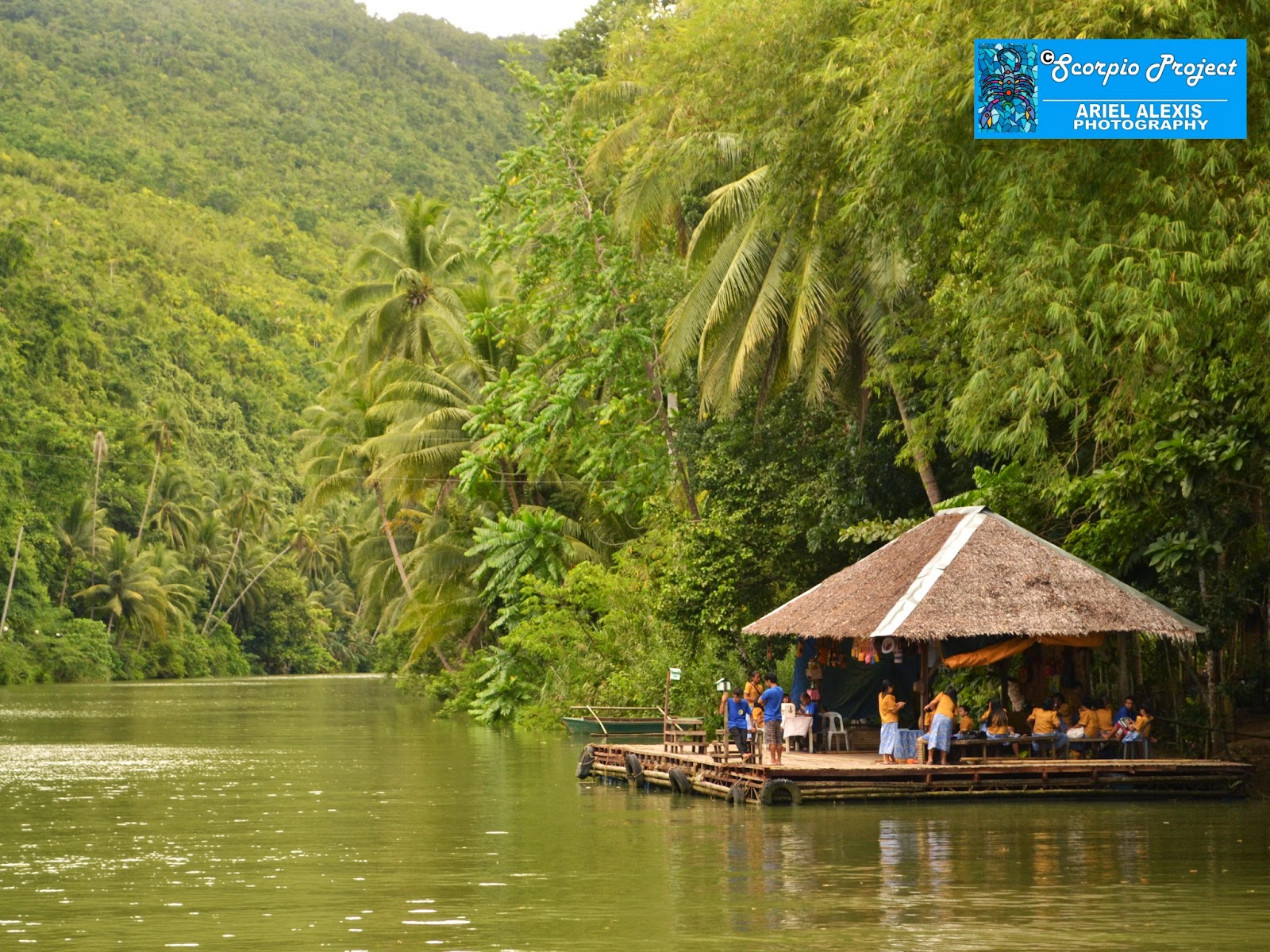
along Loboc River. Regarded as one of Bohol’s prime attractions, the enchanting
river of Loboc is best known for being one of the cleanest and greenest bodies
of water not only in the province but the entire country as well. Visiting the
old town, which was already existent long before the Spaniards came, isn’t
complete unless you get to cruise along its famous river aboard those
fancy-looking floating restaurants.

 Cruising
along the river has been part of my bucket list for quite some time. I’ve been
to the quaint little town years ago but I’ve never taken a ride aboard one of
those floating restos, until this recent tour. The nearly one-hour ride I took
started at the Loboc River Complex, with our boat meandering through the long
and winding river until it reached Busay Falls before turning and heading back
to the place where all the other vessels are docked.

 Onboard,
we were entertained by a live acoustic band. Good thing, I was able to hop into
a floating resto where the musicians played my fave pop ditties! As the vessel
took off, the much-anticipated buffet lunch consisting of typical Filipino fare
also began. All of us onboard helped ourselves with generous servings of the
mouth-watering delicacies while enjoying the green and serene landscape
unfolding before us.
 |
| Cruising along Loboc River |
During
the cruise, we stopped by along the riverbank to watch the live performance of a local sing-and-dance group composed of Loboc’s young people. There were also
some stations at the riverbank where different communities put on display their
indigenous wares for sale. We even chanced upon a few daring boys on top of a
tree, getting ready to plunge into the water. Geez, when you’re young, anything
is possible under the sun!
Trifle
with the tarsier. Cute and cuddly, their tantalizing eyes never fail to catch
anyone’s attention. Allegedly the world’s smallest primates, tarsiers are
considered Bohol’s internationally famous residents. Who would want to miss
seeing them? Certainly not me! I had a rare intimate encounter with these
lovable creatures years ago during a brief stopover in Loboc when I went there
for a look-see at the floating restos.


One
of the boatmen I met along the riverbank had about a dozen tarsiers kept in a
cage and I was fortunate enough to pet the prosimians and even put some of them
on my shoulders. Lucky me! I heard that’s no longer possible nowadays since
there’s a national directive imposing a “no touch” policy for these endangered
species. Those wanting to see the saucer-eyed prosimians held in semi-captivity
can still visit and shoot them (no camera flashes please!) at the Loboc Tarsier
Conservation Center.
 There’s
another tarsier sanctuary in the town of Corella, roughly ten kilometers away
from Tagbi, where you can see them in the wild. Since it was way out of my
itinerary, my guide and I headed straight to the Loboc site right after the
river cruise, staying with the cuddlesome creatures for roughly thirty minutes.
Short as it was, the prosimians captured my heart anew. I guess the same holds
true to the huge throngs who came that day to see them.
 |
Chocolate Hils
|
Count
the Chocolate Hills (if you can!). Undoubtedly, Bohol’s top crowd-drawer is its
cone-shaped mounds collectively known as the Chocolate Hills, which was once in
the running to become one of the world’s New Seven Wonders of Nature. Seeing
the famous hills, reported to be around 1,776,
topped my itinerary during my first visit to the province. Awed by their beauty, I kept figuring out a
way on how to count them but to no avail—I got distracted by the beauty of
those mesmerizing mounds!
 The
gently rolling, conical hills, which are largely concentrated in the towns of Carmen,
Batuan and Sagbayan, turn brown during the summer months, hence, the name. Missing it, I revisited the place, climbing
the 214 steps leading to the view deck to catch a glimpse of the renowned
cone-shaped mounds. At the summit, I, along with the other tourists, was
treated to a panoramic vista of the hills that left many of us tongue-tied for
several moments.

 Though
I’ve laid eyes on the marvelous mounds once before, I was still as ecstatic as
the day I first saw them. Still gasping for air, I gathered my wits and wasted
no time in snapping at them. I also had myself shot with the hills at my
background. On our way out, I was amazed to see busloads of foreign tourists
all raring to see Bohol’s quirk of nature!
 |
Hinagdanan Cave
|
 Hie
off to Hinagdanan Cave. Outdoor enthusiasts fond of exploring the hidden beauty
of caverns will find this cave in the town of Dauis in Panglao Island worth
their while. One of Panglao’s precious
plums, the underground cave has something that not too many caverns have.
There, amidst several stalactites and stalagmites that protrude out of the
earth's bowels, is a deep lagoon (about 15 feet deep according to one of the
cave guides I met) which will surely lure intrepid tourists to take a dip.
 Made
of limestone, Hinagdanan Cave (whose name mean’s “laddered” in the vernacular)
is very accessible from the town center. A hole of about one meter in diameter
serves as an entrance into it. Cemented steps lead spelunkers into its eerie
interior. The trail is slippery but there’s a railing that tourists can hold on
to keep their balance. Although natural light pierces through a few holes found
at the cave's ceiling, strobe lights have been strategically placed inside to
further illuminate it.
 Years
ago, I made it to Hinagdanan Cave one late afternoon. Only a few people were
there at that hour so I didn’t linger. This time, however, I made sure I’d
revisit it early in the morning so that I can catch the sunlight as it
penetrates one of the openings of Hinagdanan’s ceiling. With the help of Eman, my
cave guide/shoot director/photographer, I had myself snapped with the sun’s
rays showering me with bright light. The result? A well-captured shot that I’d
treasure forever!

 The
times I’ve been to Bohol, though mostly brief and hurried, count among my most
cherished ones for they’ve given me a lifetime’s worth of lore about the place.
I guess I’m so bewitched that each time I leave, there’s a part of me that
wants to stay even for just one more day. For the time of the next visit is
uncertain.
 Having
known a lot about its rich history, its wonderful natural attractions and its
friendly people, I’m certain I’ll always have a reason or two to go back. For around every corner of Bohol, there seems
to be a new secret or an interesting discovery just waiting to unravel itself.
So, if you haven’t figured it out yet, you’d need one weekend, if not longer,
to bask in its bewitching beauty.

 From
lovely churches to lovable creatures, to extraordinary hills to exotic
hideaways, to historic monuments to haunting museums—there’s no denying that
Bohol has everything that would make your vacay rock to the max! These, I
guess, are enough evidence that an escapade there has everything that would
surely bewitch and bolster those who bolt out to this slice of paradise. :D


 After
having my fill of those natural, historical and socio-cultural attractions, he
told me that the next best thing to explore is Panglao, which is being promoted
as an alternative destination for Boracay. The island also happens to be a
popular take-off point for divers who take the plunge at the nearby islands of
Balicasag and Pamilacan. Since then, I make it a point to drop by Panglao
whenever I’m in Bohol if only to get my share of sun, sea and sand.

 This year, I got the
chance to revisit the place as a side trip during my recent invasion of the
province’s heritage churches. Together with Julius, my tour guide, driver and
photographer, all rolled into one, I went around Panglao to explore its
precious plums.

 After
revisiting the two Spanish churches, I headed straight to the public beach in
Dumaluan where most budget-conscious tourists like me gravitate. Panglao prides
itself with having several kilometers of the finest beaches in the country,
scattered all over its fringes.
 The
more upscale resorts in Panglao, however, are still concentrated in Alona
Beach, where you can do practically anything under the sun. Said to have been
named after former Pinay sexy actress Alona Alegre who shot a film there
allegedly in the nude, its stretch of sparkling white sand is home to several
beach resorts, lodging houses, restaurants, entertainment hubs and dive
centers.
 If
you've had enough of beaches, you can go spelunking in Hinagdanan Cave, one
of the island's natural must-sees. Inside the underground cavern, a great
surprise awaits you. There,
surrounded by several stalactites and stalagmites that protrude out of the earth is a natural
lagoon which will surely lure you to take a dip.
 On
my recent visit, I made sure I’d get there when the sun is still up. So,
together with Julius and Eman, our cave guide and shoot director, I returned to
Hinagdanan Cave early in the morning so that I’ll be able to catch the light
penetrating the holes up in the cave’s ceiling.

 Upon
entering the compound where his modest abode is found, I saw some tarps and
other pictures posted on the walls featuring the little man. In minutes, we
were met by one of his sisters who led us to Bayoyoy. Seeing the dwarf up close
and personal, I was suddenly struck with pity for his hapless condition.
 Later,
his sister started sharing some trivia about their family. Both their parents
are deceased, according to her. Out of twelve children, six suffered from
dwarfism. All the other five siblings are dead and only Bayoyoy has
survived. Confined to a baby’s stroller,
the dwarf, who stands less than three feet, couldn’t talk nor walk. Now in his
sixties, he feeds on a soft diet composed mostly of milk, oatmeal and cereals.
 Seeing
him didn’t cost me a thing since there’s no entrance fee whatsoever but I
offered to give a few pesos as donation. Any amount would go a long way in
helping the family provide for Bayoyoy’s needs since their only source of
livelihood comes from a small family-owned convenience store. All told, the
Bayoyoy experience proved to be one of the highlights of my return to Panglao.
 Well,
I can only hope for the best for Panglao as far as this undertaking is
concerned. Here’s hoping that by the time the project takes off, the islanders
have prepared themselves for its possible social and environmental
implications, particularly on their coastal resources. Here’s hoping also that
the local government is prepared to handle the throngs of tourists coming
Panglao’s way who are raring to experience the island’s precious plums. :D