Want to be in a kozy
place because you have some extra time on your hands? Then hit the road until
you reach 6.4974° N, 124.8472° E. And where in the world exactly is that? Where
else but the City of Koronadal (that's the official name), the fast-growing
urban center in South Central Mindanao!
 |
Gateway leading to the poblacion
|
Mind you, the triangular-shaped city has several interesting attractions that can help you burn your boredom to the max. In recent years, this bustling capital of South Cotabato has come into its own identity as a progressive and peaceful city—a gateway to wonderful experiences that make it a fascinating destination. Take it from me, I recently made it to the city—for the nth time!—and whenever I’m there, I always have a blast!
Kozy? Yes, it’s kozy, not just cozy. People, events or places are said to be kozy when they evoke feelings of warmth, acceptance, friendliness, good humor, coolness, etc. I can’t think of a more suitable word to best describe the place and the positive vibes we felt when I, along with some coworkers, spent time in Koronadal to attend the island-wide sports competition among water utilities a few days ago. I bet you’d find it kozy, too, the moment you step into the bustling capital of South Cotabato.
Interesting tales often surround the names of many cities in the Philippines. Koronadal is no exception. Before the arrival of the early Christian migrants, B’laan and Maguindanaoan tribes used to populate the place now known as Koronadal. What is considered to be the poblacion today was once called Marbel, whose name was derived from the B’laan words, malb-el, meaning “muddy water”, perhaps in reference to what is now known as Marbel River.
Time was when I’d associate the city’s name to the Latin word “corona” or crown. Its appellation, however, resulted from the fusion of two B’laan words, koron (cogon grass) and nadal (plain). Roughly translated, Koronadal is a “plain of cogon grass.” Perhaps banking on the crowning glory of the city’s name, its drumbeaters, however, seem to be promoting it not as some grassy field but as the “Crown City of South Central Mindanao”.
 |
Alunan Avenue: one of Koronadal's main thoroughfares
|
I guess they’re on the right track as Koronadal is fast emerging as the “center of power and governance in the entire SOCCKSARGEN Region, the conglomeration of South Cotabato, Cotabato, Sultan Kudarat, Sarangani and General Santos City. As the region’s new administrative hub, the city is the center of social, economic, and political activities in the province.
 Strategically
located in the heart of Central Mindanao, Koronadal lies in the intersection of
two major road networks: the Pan Philippine Friendship Highway and the
Koronadal-Banga-Isulan Road, which connect the city to other destinations in
SOCCSKSARGEN and the rest of Mindanao. Less than an hour’s drive from General
Santos City, Koronadal serves as the crucial economic crossroad not only for
the province but for the region and the whole island as well.
 |
Moby Wave Pool—Paraiso Verde's most sought-after aqua attraction
|
Hiligaynon, the language of the Ilonggos, is widely spoken in the city. But the people also converse and write well in Cebuano, Ilocano and Tagalog. Years ago, I used to frequent Koronadal, either to do some research work or assist in the conduct of workshops for local government units. Good thing, I can understand Hiligaynon, hence, it wasn’t that difficult to interact with the locals.
 Made up of twenty-seven barangays (villages), the city occupies the northwestern part of the province. Koronadal, however, is relatively small (in terms of population size) compared to the other regional hubs in Mindanao—just a little over 174,942 people called it home in 2015; with average annual population growth rate at 1.93%. Even so, it has grown in popularity since it became the administrative center of SOCCSKSARGEN in 2000 by virtue of Republic Act 8803 and hosted the Palarong Pambansa (National Games) in 2007.
 |
Round Ball: Koronadal's most popular rotunda
|
 Koronadal sizzles with an interesting fusion of urban chaos and rural charm. Although a huge part of it is still predominantly rustic, its poblacion, which most people still call by its old name, Marbel, has been experiencing urbanization recently, spawned by the spate of commercial, agri-industrial and residential developments taking place all over the city.
 In this most recent sojourn, I noticed that traffic along the rotunda, which the locals affectionately call “Round Ball”, has become much heavier than the last time I went there. Surely, there were more cars, trucks, buses and vans going to and fro the regional center these days. If this could be considered an indicator of progress, then, by all means, Koronadal is one of the island’s highly progressive cities!
 |
| Bed numbers are on the rise in Koronadal |
 |
Moby Wave Pool
|

Truly,
Koronadal has so much to offer these days that can really make the world-weary
see it as kozy and comfy. Mall rats, for instance, won’t get bored as they have
a new shopping complex, Gaisano Grand Mall to explore. Also, the old KCC Mall
has undergone a major face-lift, perhaps in a bid to keep up with the
competition.
 For foodies, Cinco Niñas is a must-try. For me and my colleagues, it was a delight eating there. Although plain in decor, the service was nice and yes, kozy! The eats were awesome in that old town fashion and had us wishing our tummies had room for more.
Several other diners and restaurants offering their own specialties are found all over the city (Mesa Filipino Moderne, Kuya J, Razon’s, Tambilawan Native Halal, Nadie’s Chicken, Francheska Grill, Sa Balay Bistro, Apareja, Mi’Grande, among others) but the roadside resto was truly a tasty surprise, serving up a hearty lunch that warmed not only our hearts but our souls as well. After our meal at Cinco Niñas, we felt jolly and roly-poly 'til sundown!
 If you're fond of first-rate meat products, then a visit to Aloot Meatshop is a must. It’s reputed to be the major producer of the best-tasting tapa (dried or cured beef) in the whole province! You're either a sadist or a saint if you can walk out of there without buying one of their products such corned beef, chorizo (pork sausage), embutido (local meatloaf), and of course, the famous tapa).
 |
South Cotabato Sports Complex: venue of the 2007 Palarong Pambansa
|

 All sojourns have their letdowns. If there’s something I’d consider as one, that would be the current state of the South Cotabato Sports Complex. I was there for several days and I couldn’t help but feel sorry for it what it has become. The facility needs a major upgrade if only to make it a more competitive and attractive venue for big events in Mindanao in the future. With Koronadal playing a larger role in both the local and national scenes, I guess the local government should make it one of the city's priorities, if only to restore the complex to its former glory.

From a mere plain of
cogon grass to a bustling regional center, Koronadal has truly come of age.
Although I’ve been there on a number of occasions, I still feel that I’ve
barely scratched the surface of this wonderful city. So much more to discover,
yet so little time on my hands. If time and resources permit, it will surely be
one of the places I’d like to revisit. Who knows, I might be back in Koronadal
sooner than expected! 😃

 Many
legends have been woven around the origin of Pangasinan’s most popular tourist
destination—the Hundred Islands National Park (HINP) in Alaminos City. One of
them has it that the amazing islands and islets numbering 124 (during low tide)
were created by Bathala to
immortalize the intrepid warriors of an ancient kingdom in the form of unique land
masses scattered all over the vastness of Lingayen Gulf so they could keep
watch of their territory against all invading forces till the end of time.


 Indulge me, please? I’m fond of legendary stuff so I’ve included this legend in my blogpost on the amazing islands and islets. Coming across such legend from my grade school textbooks a long time ago, I grew up fascinated with the idea of setting foot there one day. When that chance finally came my way this year, I knew I had to post something about it, legends, leisure and all.


 Seen
from afar, the unique formations will strike visitors as a group of oversized
turtles. Truth is, they’re rich ecosystems replete with white sands, coral
caves, shallow waters, colorful fishes, and rare flora. Science has it that the
islands, estimated to be over two million years old, are ancient corals in an
area that were part of the seabed of a prehistoric sea.

 At
a time when people were scampering to their chosen destinations for one last
summer hurrah, I found the perfect opportunity to gravitate up north and
finally tour around the Hundred Islands. This
is it! I joyfully told myself. At
long last, I’d get to see them (or
some of them) for the first time. For me, they’re the picture-perfect
locales for my last summer hurrah—also my first out-of-town sojourn during the
rainy season this year!

 First,
a little back story. Weeks ago, my friends (some of whom are based in Metro
Manila) and I talked about exploring the islands. That time, most of us were
noncommittal due to conflicting schedules. Besides, who would want to go for
one last summer hurrah when the rainy season has already set in? (LOL!) As days
passed, however, four wonderful people decided to give it a go—Juju, Baby,
Letty (who brought along her daughter, Abbi) and me!
 So
off we went to the northwestern part of the province one Saturday midnight. Mind
you, going to HINP these days is fast, light and easy—if you’re onboard those Alaminos-bound
aircon buses, a number of which are outfitted with wifi connection and built-in
toilets. Our group boarded one huge bus
from the Five Star Company’s fleet at its Cubao terminal. Travel time was
roughly five hours, including stopovers.


 Fortunately, the two tricycle drivers we hired knew of some cheap accommodation (Php3,500 for all six of us!) in the village of Lucap, just a few kilometers away from the HINP. After billeting ourselves for an overnight stay in the transient house, we then spent the next few hours dozing off in preparation for our adventure to the islands.

 By
6:30 in the morning, we were on our way to Lucap Wharf, the jump-off point for
hopping around the Hundred Islands. Motorized boats for rent are docked there. Arriving
at the wharf, we could already see some of the small islands albeit from a
distance.


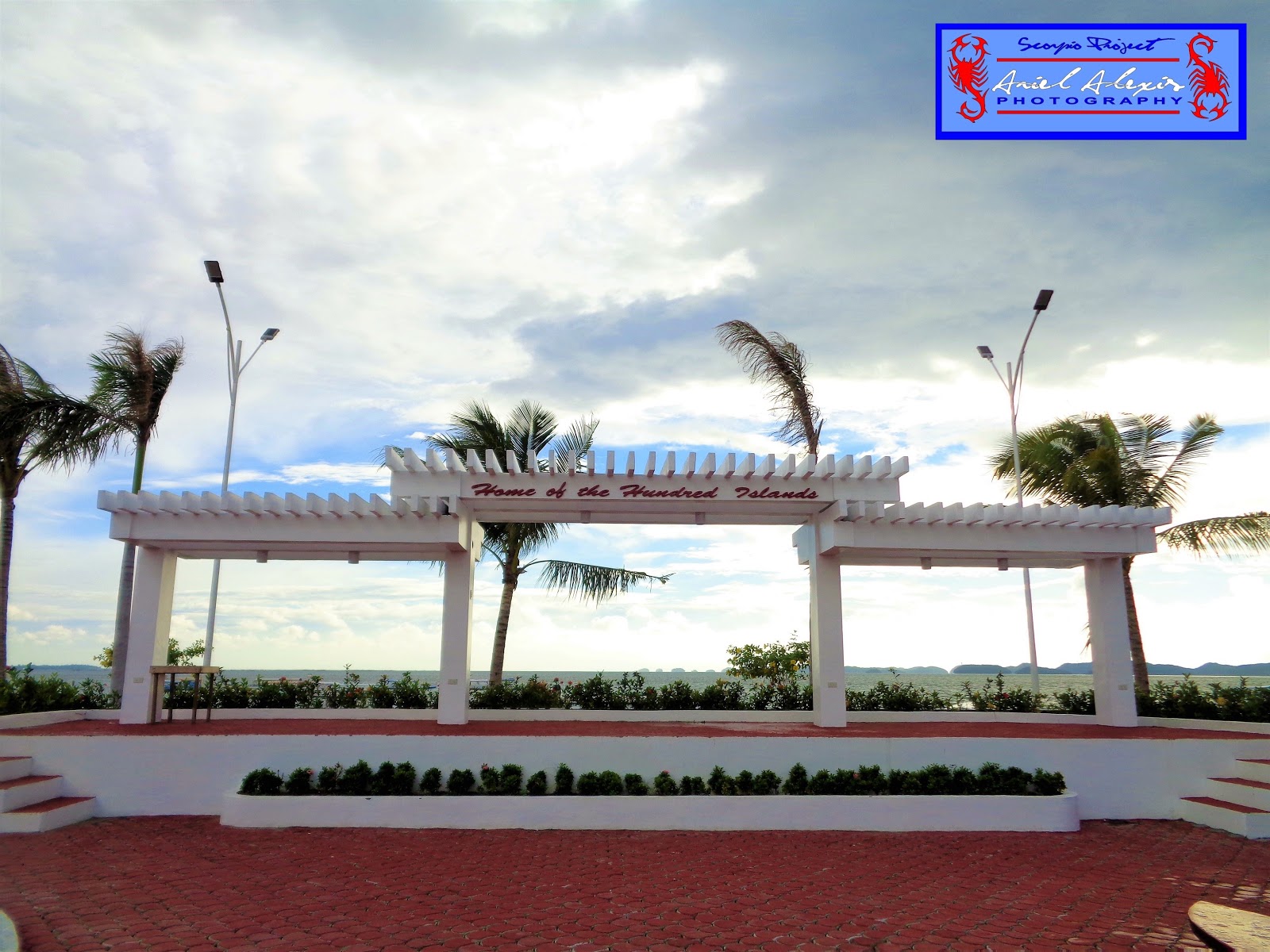
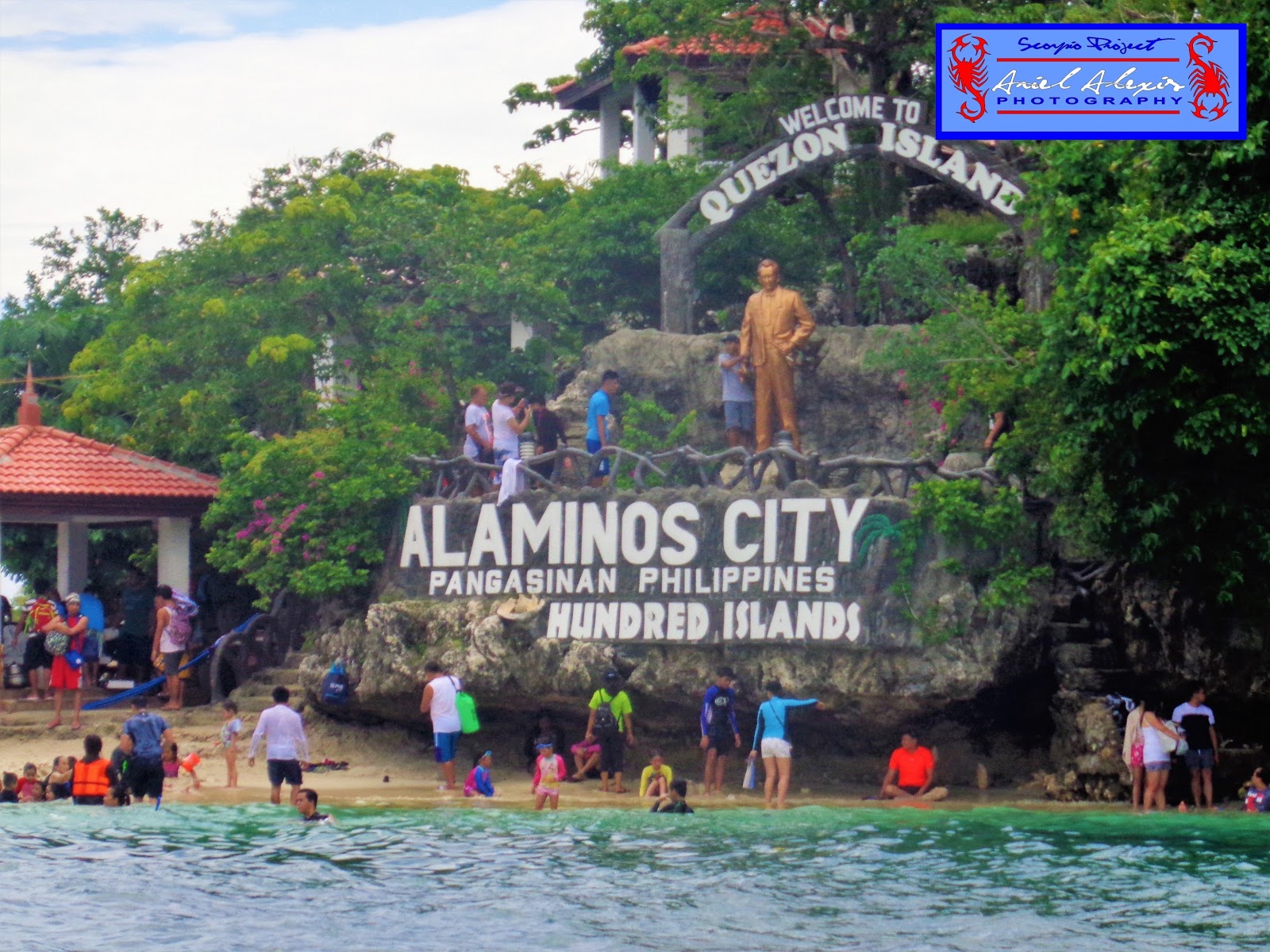
 Travelers fond of selfies, duofies and groupfies will have a blast shooting themselves to the max at the welcome signage. Of course, we didn’t pass up on the chance to have our photo ops, too! A friendly advice though before embarking on your sojourn: Get your smartphones and gadgets some waterproof cover to protect them from the splashes as you go about hopping from one island to another.


 Among
the popular islands, there was one which caught our fancy—Pilgrimage Island. Standing
on top of it is the 56-foot statue of Christ the Savior, the newest attraction awaiting
pilgrims who want to observe various religious festivities all year round, most
especially the Holy Week, in that part of Pangasinan. The pilgrimage site
offers a breathtaking panorama of the 1,884-hectare national park.
 We
opted for a tour that only had two stopovers, one in Governor Island and
another at Marcos Island. Governor
Island boasts of a 200-step staircase offering a good vantage point of some of
the islands while Marcos Island has a 20-foot lagoon inside a cave where
intrepid tourists can dive into.


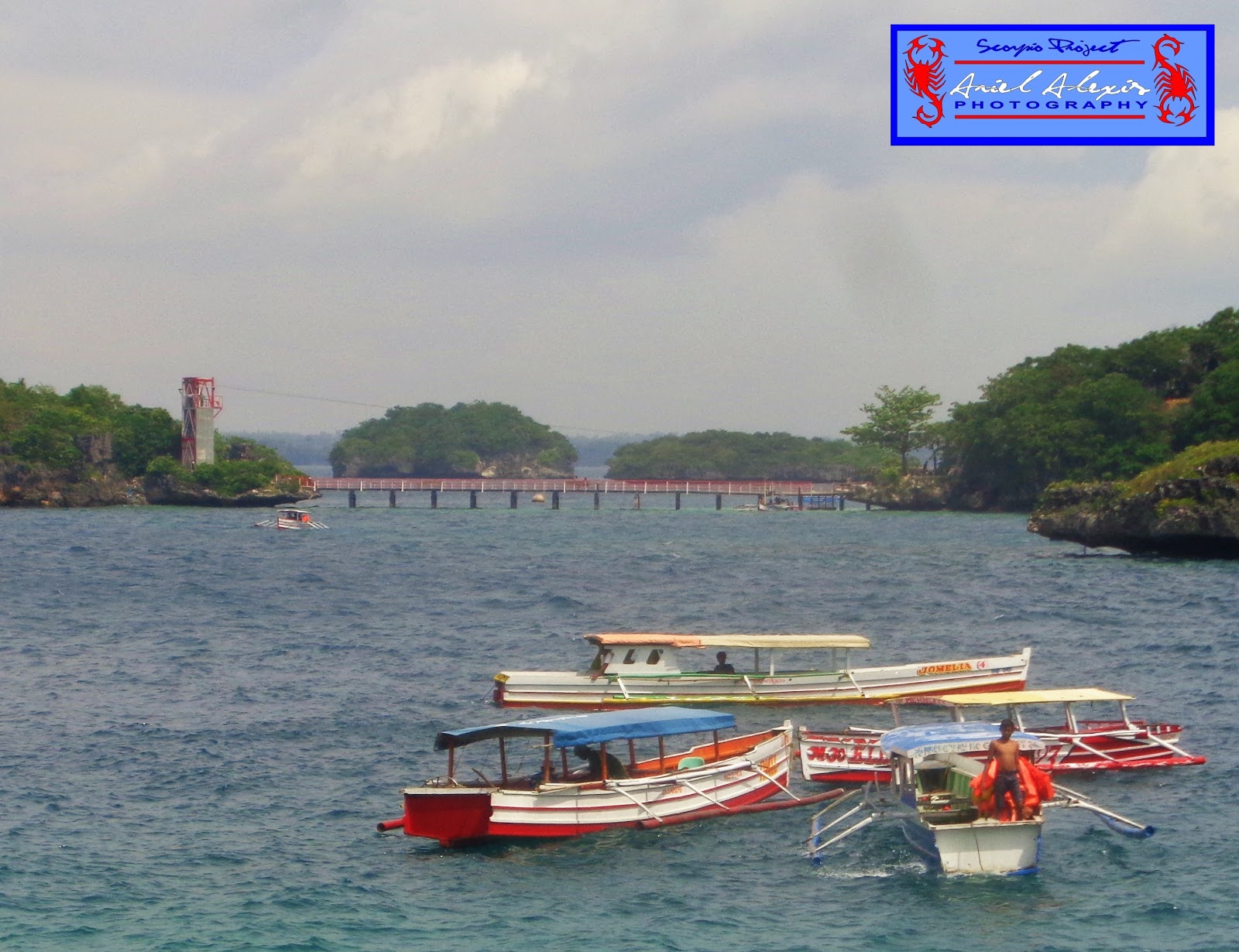


 Even
though we lingered in these two popular destinations, we were able to see a
number of other less popular islands and islets bearing such esoteric names as
Cuenco, Clave, Quirino, Lopez, Milagrosa, Monkey, Old Scout, Paniki, Romulo, Scout,
Cathedral, among others, on our way back to the mainland.


 Going around the fascinating islands and islets took us roughly three hours. Whew, it was one helluva joyride that really had our adrenalines rushing! We would have wanted to explore some more but the huge waves that we encountered earlier made us wary. So, before noon time, we were already ashore where we did some shopping for shirts and other souvenirs at the row of stalls near the wharf.


 You’d
never fully understand a place unless you’ve tasted its homegrown treats.
That’s why we also tried some delicacies Alaminos is known for—tupig (sticky rice cake wrapped in
banana leaves and grilled over charcoal); binungoy/binungey
(sticky rice cake cooked inside bamboo tubes); puto Calasiao (steamed rice cake from the town of Calasiao); and the
popular boneless bangus (milkfish)
and the eponymous longganisa (local
sausage).
 By
the way, when you’re in Alaminos, there are at least two names worth
remembering for the best dining experience: Maxine by the Sea and Eliana’s. If you want
to enjoy a sumptuous meal near the sea, then Maxine is the perfect place to be.
Eliana’s, on the other hand, is worth visiting if you want to listen to a live
band while dining or drinking.
 Short as the sojourn was, I’m so awed by the raw beauty of the Hundred Islands of Pangasinan. Humbled, I should say. Here’s a veritable place where you can really experience for your yourself the magnificence of God’s creativity—or Bathala if you wish to call him. And even if the origin of those islands and islets was just the stuff of legends, I still felt humbled and honored to have been given the rare chance to “meet and greet” a few of the legendary fierce warriors of yore, even in their non-human form! 😃


