Saturday, June 26, 2010

Sliding Above Lake Sebu’s Seven Falls


pic courtesy of E. Gales
I’d been raring to do it for the longest time. But something often got in the way of my best-laid plans in the past.  Recently, in one blink of an eye, the moment I’ve long been waiting for was suddenly unfolding before me.

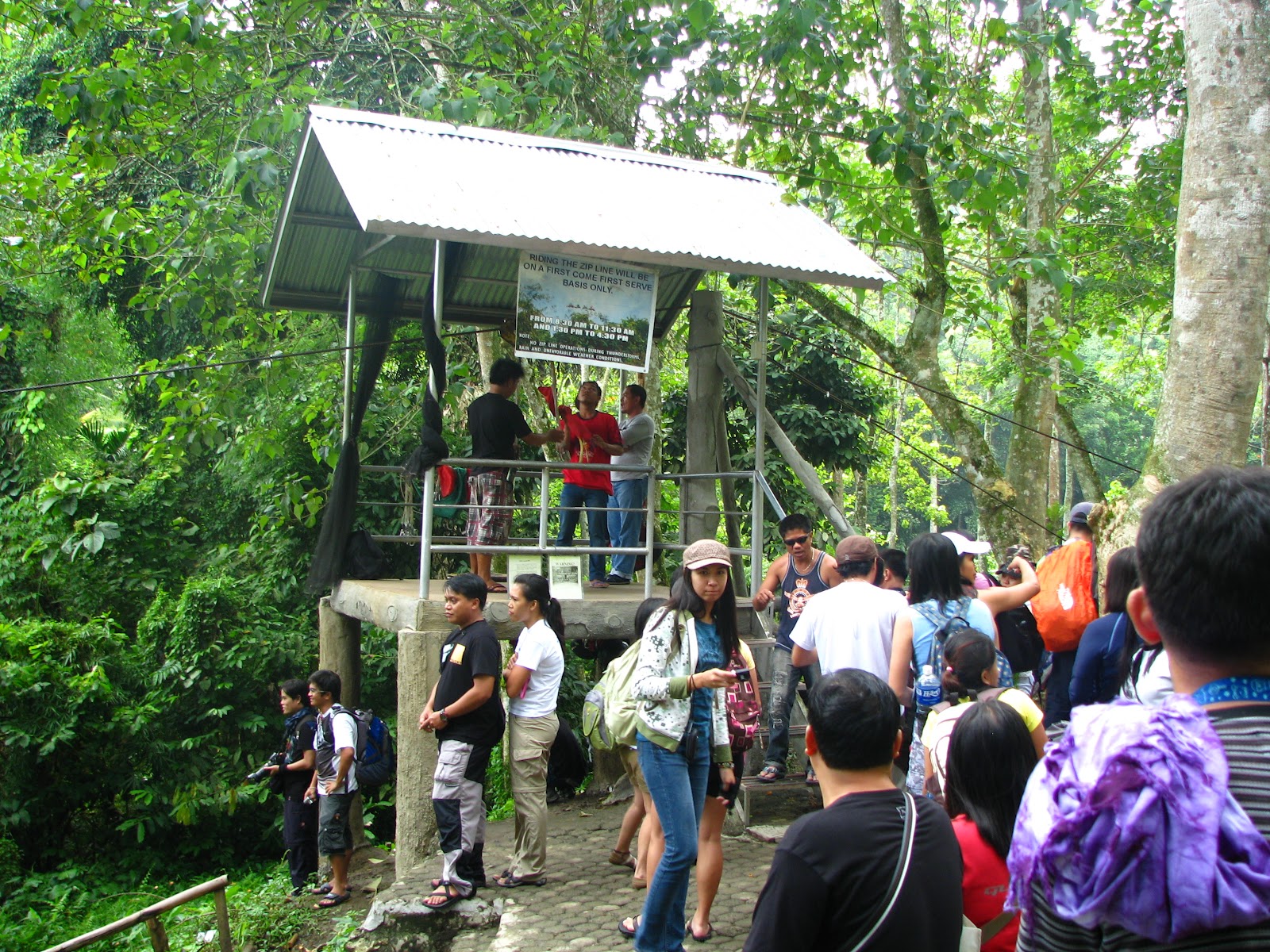
With quiet aplomb, I climbed a short stairway leading to a steel platform where I will be taking off for what would eventually become the reality of a flight of fancy.  But I wasn’t taking that helluva “death slide” alone; I was about to fly with a fellow travel photography buff, Leo, who, I think, must have done it a number of times in the past. Before our turn at the zip line came, there were several other tourists who’ve already crossed the deep, wide chasm between the stage where we stood and the other end of the line.

Stepping into the platform, my zip buddy and I were geared up by the crew with some kind of protective suit. Then they attached our harnesses to the cable. To prepare us for our flight, one of the staff kept telling us to relax and enjoy the ride. Quickly, I held on to my digital camera, which was strapped around my neck, and touched the red button to start recording what was to become my first zip line experience.

The two of us were part of the 60-plus entourage who came all the way from Davao City just to experience the “death slide” up in the highlands of Lake Sebu. Leaving the city in the wee hours of the morning, the bus carrying our boisterous group reached the heartland of the T’bolis at about 7:00 in the morning.

We then proceeded to Lake Lahit, one of the three bodies of freshwater dotting the municipality that’s known as South Cotabato’s summer capital. There, our group had a hearty breakfast of fried tilapia, scrambled eggs, and piping hot rice at one of the lakeside eateries along the highway.
After eating, we negotiated for a habal-habal (which accommodated only two passengers per ride) that would take us to Falls 1, the first of seven magnificent cascades that’s been charming Lake Sebu’s visitors. Warning: the habal-habal ride isn’t for the fainthearted. It would be best for those with motion sickness who want to go there to just hike for a kilometer to get to the first falls. For there was a whiff of danger every step of the way as we raced through the winding stretch.

There can be no margin for error. One wrong maneuver of the driver over the muddy path could send everyone tumbling down to—heaven forbid!—a fatal crash into the ravine. But it’s the peril and suspense that spiced up that trek of mine into the first of the seven cascades.  Good thing, our driver knew his way around that serpentine dirt road. Otherwise…

I was beginning to enjoy the lush scenery when the thriller of a commute suddenly ended as we reached a sprawling vacant lot where a number of motorcycles and other vehicles were parked.  From there, we hiked towards Falls 1 where we had a grand time snapping ourselves and taking in the beauty of the breathtaking cascade. After seeing enough of the first falls, we hiked towards the staging area of the first zip line where I had my daredevil ride. 

“On the count of three, sirs…one, two, three!” the staffer barked as he released the harnesses that held together two devil-may-care shutter guys whose hearts were almost bursting with hysteria as they slipped into their mid-air adventure.

Geez, this is it! I thought as I felt the cool breeze brushing against my face. Before I could say anything, there we were, speeding at 120 kph into the other end of the 700-meter zip line. Ahhhhhhhhhhhhhhhh!,” I roared endlessly as we dashed at breakneck speed from the foliage-covered ravine into the great divide. I held my camera tightly for fear that it would escape my grip and fall into the 700-feet deep expanse underneath us.

As we zoomed up in the air, I sensed the surge of adrenaline pumping into my bloodstream. I felt my heart skip a beat, my pulse quicken, my spirit teeter with tension as we darted past the picturesque vista below us. Less than 40 seconds later, we slowed down, reached the drop zone and then ground to a halt.

The crew then rushed and helped us get out of our suits and harnesses. So, there, in one fell swoop, my spellbinding flight of fancy was over. But that was just the first one. We still had to conquer another “death slide”, albeit a much shorter one—300 meters, if I’m not mistaken—which lasted for about 20 seconds.

At the speed we were doing the second zip, I hardly caught a glimpse of the breathtaking charms of Falls 3, 4 and 5 hundreds of feet below us. Later, I just took some distant shots at those three cascades for posterity's sake. Since reaching them entailed trekking for almost an hour, I also passed up the chance to see Falls 6 and 7. Instead, I joined most of my fellow zippers who lingered at Falls 2, talking about our experiences at the zip line while basking in the beauty of the lush surroundings.

Never mind if I didn’t get to see the five other cascades up close and personal, I thought. For it’s the zip wire odyssey that really counted the most. It was a fantasy fulfilled for this incorrigible thrill-seeker, a rare opportunity to upsize my sense of self and push my personal boundaries to the max. It was an exhilarating joy ride that gave me a wispy but gripping aftertaste of life on the edge.

Organized by RTours, a group of Davao-based travel aficionados, the zip line adventure we had in Lake Sebu has become one of the many reasons why throngs of tourists these days are heading towards that part of Mindanao for some adrenaline rush. 

In different parts of the island, a number of such attractions have sprouted overnight in response to the growing demand for extreme forms of adventure. But I think Lake Sebu’s thrill rides are a cut above the rest. I guess nothing beats the magnificent views that await those who zip there, most especially the town’s awe-inspiring Seven Falls. 

Here's a video showing my encounter with the death slide...


More pics:

pic name pic name pic name

Sunday, May 23, 2010

Trekking to Surigao del Sur’s Tinuy-an Falls


Having seen so many waterfalls in different parts of the country, including world-famous Magdapio (that’s Pagsanjan to you, which should have been named Cavinti since it’s found in that town, not in Pagsanjan, Laguna), mysterious Cambugahay in Siquijor, and slim yet stunning Katibawasan in Camiguin, nothing seemed so breathtaking to me anymore. Seen one, seen them all, I thought. 

That was until I found myself gazing (or was it gaping?) one blissful morning at the picture-perfect magnificence of one cascade hidden somewhere in one of Surigao del Sur’s lush rainforests—Tinuy-an Falls. Suddenly, I was at a loss for superlatives that would aptly describe the three-tiered cascading wonder found just about an hour away from the concrete jungle that is Bislig.

What’s so special about this beauty? For one, it’s often touted as the country’s Little Niagara Falls with an awe-inspiring drop of about 55 meters (180 feet) high. Anyone who’s been to or seen a pic of New York‘s famous falls would surely notice the striking resemblance. Also, Tinuy-an is considered the Philippines’ widest falls with a width of about 95 meters (312 feet).  With its three-tiered flow, it’s undoubtedly one of our most picturesque.

The visit to Bislig’s beautiful cascade came part of a marathon tour of two attractions, the other being the Enchanted River in the neighboring town of Hinatuan. Through a long-time friend, I learned about the adventure being organized by some Davao-based travel aficionados. Immediately, I decided to make myself available one weekend so I can join the escapade to Surigao, which was a homecoming of sorts for me having last visited the place a couple of decades ago.

Leaving Davao City in the wee hours of the morning, the bus carrying an eclectic bunch of nature trippers reached Mangagoy after a night of meandering through the highways of three provinces: Davao del Norte, Compostela Valley and Agusan del Sur. Most of us were snoozing en route to our destination when we were evicted out of dreamland as the bus drove towards a long, potholed stretch that is the old PICOP road. Geez, this used to be a fine access road but it seemed like it had seen better days.

In Mangagoy, we took a quick breakfast and scurried to the secluded village of Borboanan in the outskirts of Bislig where the falls is found. The trek to Tinuy-an gave us a panoramic treat of the countryside, including some attractions that made me realize how blessed we are for possessing so much rustic, virginal beauty—a placid lake, a mighty river, a dense rainforest, verdant fields, and several quaint villages whose folks seemed star-struck upon seeing our vehicle pass by, as if it carried some pop icons they adored.

Minutes later, the bus came to a halt somewhere near a flowing river. This must be the place, I thought. Along with the others, I took my stuff and jumped off the bus.  Then I heard the thunderous roar of falling water and walked towards the source of the sound.  And there it was—the wonder that everyone came to see—gushing, flowing, roaring and beckoning us to explore her grandiose beauty.  Tongue-tied, I held my camera and took my first few shots of our little Niagara.

If there’s something I’d consider an icing on the cake to the tour, it’s none other than the cool and spectacular rainbow that came into our view while we were exploring Tinuy-an. I’ve never been that close to one before so the sight of it thrilled me no end, reminding me of some popular ditties about rainbows including that original rendition by Kermit the Frog. With lightning speed, I took out my camera and snapped at the spectacle before it vanished from our sight.  Hmmm...it made me wonder whether it was a sign of welcome from some unseen power guarding the falls, a goddess perhaps?

If there’s something I failed to accomplish during the tour, that would be reaching Tinuy-an’s peak. For what I first thought was just a walk in the park turned out to be one uphill struggle. Geez,  I was already having trouble breathing after making it to the initial flight of stairs leading to the falls so I thought I’d die if I went on to the next! With much regret, I had no choice but to go down, eating my heart out as I watched our younger companions eagerly scaling the steep stairway with so much ease. Damn, I need a cardio workout—pronto!

After browsing over what Arthur, our tour organizer, and his gang of photo enthusiasts had taken and uploaded in Facebook, I couldn’t help but drool and be envious of the others who’ve made it there. So, if there’s something I want to do upon seeing Tinuy-an again, that would be making it to the falls’ summit.  I can only wish that such closure would happen not in another decade for fear that I may no longer have the stamina to go there. As the cliché goes, the mind may be willing but the flesh might be too weak.

Here’s a sneak peek at the Philippines’ Little Niagara…:D


Monday, May 17, 2010

Entranced by Surigao del Sur's Enchanted River


In a little known rustic town in Surigao del Sur, shielded from the chaos of urban life and the harsh waves of the Pacific by a dense rainforest and a lush mountainside, lies a slice of paradise that swept me off my feet the moment I saw it—the Enchanted River of Hinatuan! 


I’d been to various towns in the province long before it became part of Caraga Region while working as a researcher. During those trips, I often heard some interesting stories about a deep and dazzling river with crystal clear waters somewhere in the southern tip of Surigao del Sur. Hearing those tall tales whetted my appetite to explore the place. Time and circumstance, however, prevented me from doing that at the time. 

So, when I got wind of a tour being organized by some adventure-hungry friends, I readily signed in for the expedition. I hadn’t been to Surigao in ages so anticipation to see it anew ran high, most specially that spectacular piece of wonder in Hinatuan that I’ve been yearning to explore. 

The tour itself was a hectic 18-hour affair (including the return trip) with the itinerary consisting of visits to two locales: the amazing Tinuy-an Falls in the city of Bislig and the spellbinding river in Hinatuan. So, together with about 40-plus wide-eyed travel aficionados and photography buffs from Davao and elsewhere, I was off to the southern part of Surigao in the wee hours of a Sunday morning.  

By 6 a.m., the bus carrying our entourage reached Mangagoy, the main commercial district in Bislig,  after a bumpy five-hour ride through the countryside. Still dazed and weakened by the lack of sleep, almost everyone on board was eager to grab a hot cup of coffee to perk us up for the much-awaited trek to Tinuy-an Falls where we later lingered for about four hours. 

After basking in the beauty of the falls, we headed for our next destination. Passing by Bislig’s coastal road, we were treated to a magnificent view of the Pacific’s waves hitting the city’s shores. As the bus meandered through the boulevard,  I noticed something different about the city.  Life there seemed to have taken on a slower beat with the closure of PICOP, one of the country’s largest paper mills. Gone was the upbeat spirit that used to pervade it during my previous visits.

As we are about to reach the city’s dilapidated wooden bridge, I overheard a chat between Arthur, our tour organizer, and a fellow tourist. “That bridge (referring to the new one being built adjacent to the old structure) holds the international record of being the ‘longest’ one,” Arthur said in jest. “It’s the ‘longest unfinished bridge’ in the world! Almost ten years in the makingand still counting,” he added. And why is that? “Only this city’s esteemed congressman knows the answer,” he quipped. 

Upon reaching Hinatuan, our bus drove straight into one of the town’s eateries to heed the call of our tummies. To everyone’s delight, lunch consisted of a sumptuous seafood fare—crabs, shrimps and grilled blue marlin. In minutes, the small tables were readily occupied by tired, hungry souls and the mouth-watering feast was gone in minutes. 

Sated, we then hopped into the vehicle again for the exciting journey to the river. On our way there, many thoughts suddenly ran inside my head.  What’s so enchanting about Hinatuan’s river? How come people flock there? Are we going to fall into a spell once we see it? Hmmm... I couldn’t wait to find the answers.
After negotiating through a rugged dirt road leading to the spot, we got to our destination.  Initially, I expected to see a quiet, uninhabited river with no amenities whatsoever. To my surprise, there were picnic huts and tables all over the place, giving it the semblance of a sought-after tourist attraction.  I also thought that only a handful of frolickers would be around as it was a secluded place. To my chagrin, the river and its vicinity was full of tourists from all walks of life!  Almost every nook and cranny was teeming with people, young and old, singles and couples, parents and children.

Nonetheless, my dismay flew out of the window the moment I laid eyes on the blue, sparkling river (or is it a lagoon?) below the cliff from where I stood.  Geez, it was the most picturesque body of water I’ve ever seen in my entire life. I found myself tongue-tied while watching the water seamlessly progressing from emerald green to pale blue and finally to dark blue somewhere in the middle where a deep crevice seemed to have naturally formed. Quickly, I took out my camera and kept on snapping here and there, capturing the river’s best angles as much as I could.

According to the locals, the river’s depth, particularly the dark blue portion, is estimated to be around 24 meters (80 feet).  Gazing for minutes at the enchanting spectacle, I felt some invisible force beckoning me to dive into the deep blue waters.  Maybe that’s the enchantment this river is said to possess, I thought. 


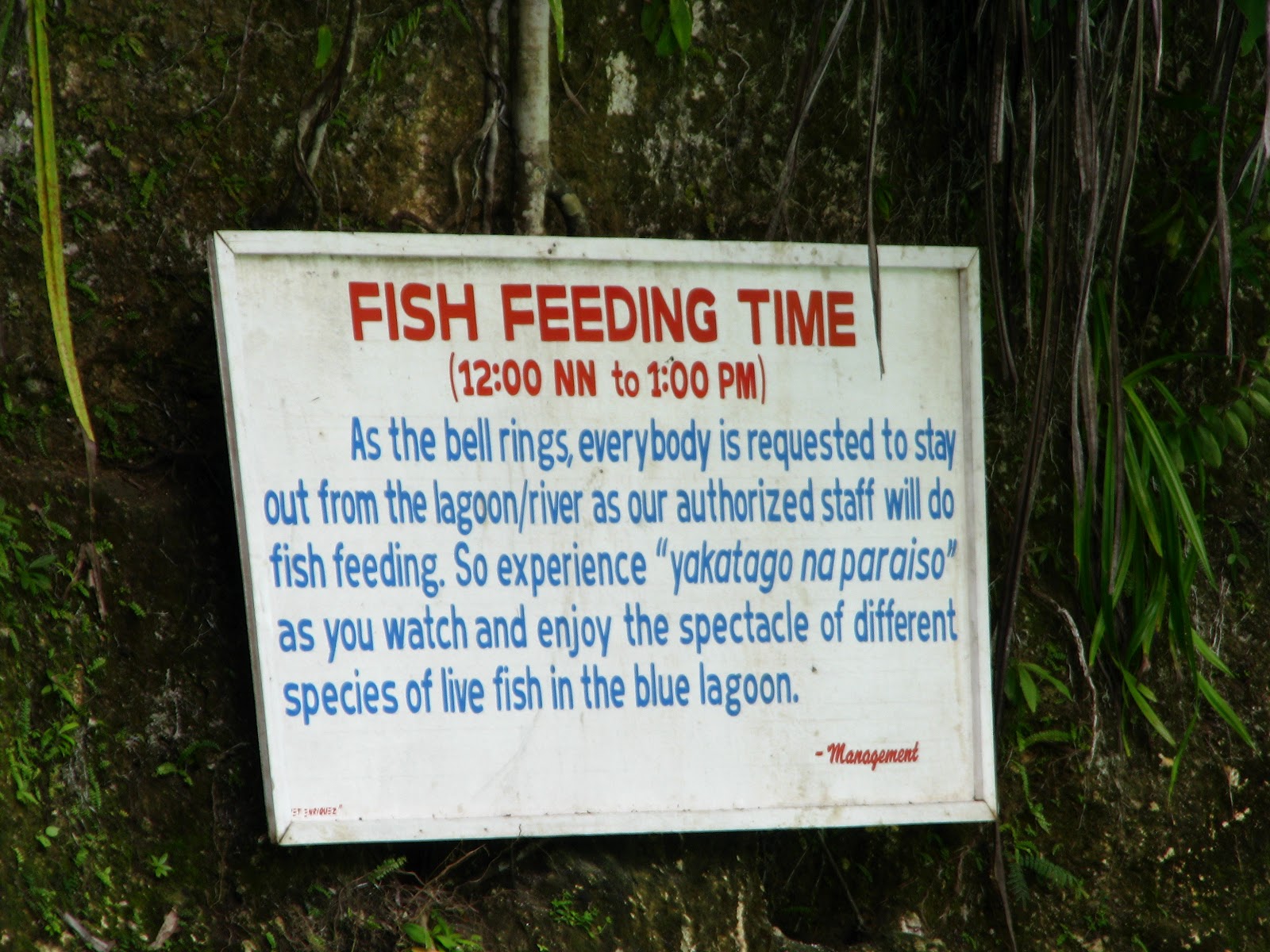
As my diving skills aren’t up to par, I opted for a quick dip somewhere in the lagoon’s shallower waters on the right side. While swimming there, I noticed a signboard across the river which reminded everyone to get out of the water at noon time.

Intrigued, I later sought explanation from one of the caretakers who eagerly told me that various fishes come out and swim in the river at noon, waiting to be fed with bread crumbs and the like. How interesting, I told myself. Too bad we missed that feeding session. I also learned that the locals never harmed nor attempted to catch the fishes there for they believed that these are enchanted and that punishment from some unseen power awaits those who dared.

After wading for a few minutes in the river’s brackish waters, I got out to change clothes, took my camera again and snapped all over the place to my heart’s content. Roaming around, I couldn’t help but marvel at one of God’s most stunning creations in that part of the country.

It was almost 4 p.m. when Arthur decided that it’s time to leave. As I joined the others who were trooping back to the bus, I silently prayed for another chance to return and relive the enchantment that I experienced there. I also wished that the wonderful folks of Hinatuan would go to great lengths to protect their precious river so that it would continue to enchant more and more people for generations to come. 

Here's a video that captured the magic of the Enchanted River...:D


Sunday, March 21, 2010

Mystified by Malagos' Resorts


Malagos never fails to mystify me. The mystery-shrouded watershed and its neighboring environs dazzle visitors with the sheer beauty of the serene landscapes, making you look forward to the next visit. I’ve been to Malagos more than a dozen times already but each time I go there, I get to learn something new that somehow helps demystify this sought-after haven in the outskirts of Davao. 

Home to nearly 6,000 Davaoeños, Malagos is one of the 182 villages that make up Davao City. The name Malagos is said to have been derived from the word mala-agos, which suggests continuous flow even during the dry season. This can be attributed to the presence of a vibrant watershed there that’s being maintained by the local water utility. Whenever I want to shut myself off from the rest of the world, I head for Malagos and immerse myself in any of the three sanctuaries found there: Malagos Watershed and Park, Malagos Garden Resort and the Philippine Eagle Center.

Located about 33 kilometers away from the city proper, Malagos Watershed is considered as one of the most vital sources of the city’s water supply. Way back in the 1920s, it was in Malagos where Davao’s first communal water system was established. At present, the local water utility relies on the 235-hectare Malagos Watershed to meet the water supply requirements of the southern portion of the city, particularly the Calinan area. Found within the watershed and park are a number of water facilities, including filters, a chorinating facility and a dam.

At the Malagos Park’s entrance, your attention will be drawn to a row of souvenir stores and fruit stalls where tourists can buy many of the local fruits sold there—rambutan, mangosteen, pomelo, durian—for a song! Inside, there’s a small playground and a picnic ground where you can while away time. There are a number of picnic huts where families and individuals can bask in the loving arms of Mother Nature. Some members of Davao’s indigenous communities also roam around the park to sell handmade bracelets made of natural materials. 

But there’s one more attraction there that really got my attention: the huge pythons that have been domesticated. If you’re not wary of reptiles, you can take pictures with the creatures wrapped around your shoulders. 

Near the watershed park is another sanctuary for nature-trippers: Malagos Garden Resort, which is a sprawling inland nature-themed resort replete with accommodations and function rooms, seminar halls, a restaurant and coffee shop, well-manicured gardens, a bird park and butterfly sanctuary, a swimming pool, a children’s playground, among others.   

The resort is also home to the famous Philippine orchid, Vanda Sanderiana, popularly known as waling-waling as well as indigenous birds and other wildlife species. The works of National Artist for Sculpture Napoleon Abueva adorn the gardens of the resort.   

But, wait, there’s more to Malagos than its spectacularly serene surroundings. Back at the Malagos Watershed and Park, there’s this attractive creature whose face you must have seen somewhere—magazines, newspapers, TV, the Internet. But you should see him in the flesh. Endowed with features that cause many heads to turn for a closer look, his animalistic appeal make him one of the most sought-after attractions in Davao City. 
 
Standing about a meter tall and weighing approximately 5 kilograms, he’s a sober-looking creature who sports a patrician profile highlighted by a pointed, curved beak and luminous bluish eyes. On his pate rests a headdress of light brown feathers that form a crest when raised, giving him a war god’s appearance. His dark brown dorsal feathers, thick and neatly tucked, complement a fluffy white chest. His broad wings, spanning about two meters, allow him to rise almost vertically to maneuver between trees, branches and vines.  

Gifted with a squared-off tail, powerful legs and sharp claws, he’s an excellent hunter who’s always ready for the kill. He feeds on a wide variety of forest species that include squirrels, snakes, civet cats, hornbills, and occasionally bats and monkeys. His primary prey, however, is the flying lemur. He’s none other than the mighty Sir Andy whose species called Pithecopaga jefferyi or the monkey-eating Philippine eagle I had the opportunity of meeting live in the flesh, up close and personal at that, for a spontaneous photoshoot that left me in awe.


The continued destruction of their natural habitat has significantly reduced the eagles’ population to about 500 or so birds. They’re scattered in about four out of the over 7,000 islands making up the Philippines—Luzon, Samar, Leyte and Mindanao. Their main breeding season is spread out from September through February. Laying only one egg, they rear one offspring every two years. Their life expectancy, particularly those in the wild, is anywhere between 30 to 60 years. 

At Malagos, Sir Andy and his kind have been successfully bred in captivity through the efforts of the Philippine Eagle Foundation (PEF), a private non-stock, non-profit organization which serves as the principal organization working to save the eagle and its forest environment. 

Want to catch a glimpse of the legendary creature whose advent has kept hopes ablaze for the country’s endangered wildlife? Then head straight to Malagos and be one with the best that nature can offer.   :D