Hakuna
Matata—this became one of my favorite mantras after watching The Lion King many
years ago. Roughly translated, the Swahili phrase (which happens to be the
title of a song featured in the popular animated film) means "no
worries", or the kind of attitude that I’d like to associate with what the
French call joie de vivre or “the joy of living”.
 |
| Ayala Centrio: one of the most frequented shopping complexes in CDO |

Like
so many people, I’ve been trying to lead a life that’s worry-free. But then
again, life’s a bitch most of the time. Like it or not, trials and tribulations
come our way. That’s why we must have the courage to stay afloat, not letting
our worries get the better of us. Carefree, that should be the attitude if we
want to live longer, I guess.
Me?
I practice a simple approach in keeping my worries at bay. Hard as it may be, I
strive to be carefree no matter what the circumstances are. How? I drive. Long
distance, that is. Shhh, don’t laugh now but that’s my stress therapy. The
escapist in me gets a kick out of driving to faraway places.
 |
| CDO's changing cityscape |
In
recent months, some personal circumstances have made life kinda rough and tough
to handle. I wanted out, at least for a few days. Seeking some breathing space,
I decided to hit the road to Northern Mindanao. Destination: CDO. That’s
Cagayan de Oro, in case you don’t know.
In
the “City of Golden Friendship”, the chances of getting infected by its
feel-good vibes run high. Exag as it may seem, there’s something magical about
the smiles and warmth of Kagayan-ons that can ease anybody’s worries even for
just a few days. Believe me, the folks there are probably the best versions of
the happiest Pinoys in the planet.

It wasn’t my first time in CDO so I was far from clueless about what it can offer to the woeful and world-weary. The city teems with many attractions that can pumped up the right dose of adrenaline and endorphin into your sagging spirits. Think river rafting, zip lines, rappelling, spelunking, dragon boat racing, the works!
 There’s
so much to see and do in the city that can help you find your balance and keep
you light and easy. It has everything and anything for any adventure junkie, be
it in air, land, or water. You just have to discover them yourselves and choose
something that suits your wild.
There’s
so much to see and do in the city that can help you find your balance and keep
you light and easy. It has everything and anything for any adventure junkie, be
it in air, land, or water. You just have to discover them yourselves and choose
something that suits your wild.

It wasn’t my first time in CDO so I was far from clueless about what it can offer to the woeful and world-weary. The city teems with many attractions that can pumped up the right dose of adrenaline and endorphin into your sagging spirits. Think river rafting, zip lines, rappelling, spelunking, dragon boat racing, the works!
 There’s
so much to see and do in the city that can help you find your balance and keep
you light and easy. It has everything and anything for any adventure junkie, be
it in air, land, or water. You just have to discover them yourselves and choose
something that suits your wild.
There’s
so much to see and do in the city that can help you find your balance and keep
you light and easy. It has everything and anything for any adventure junkie, be
it in air, land, or water. You just have to discover them yourselves and choose
something that suits your wild.
For
this recent sojourn, however, I wanted something more laidback so I focused my
sights on two popular attractions that CDO is identified with: Macahambus Cave
and Gardens of Malasag Eco-Tourism Village.
For the longest time, I’ve been lusting after these spots because of
their historical and cultural significance.
 |
| The road to Macahambus Cave |
Historic Cave


Hidden
somewhere in the hilly village of Lumbia, Macahambus Cave is included in the
bucket list of many weekend warriors. Like them, I’ve been raring to see this
attraction for the longest time but, for one reason or another, I failed to
squeeze it into my previous itineraries. This time, however, I made sure that
I’ll get to explore it once and for all, come hell or high water.
 |
| Entrance to Macahambus Cave |


For
dabblers in history like me, this cave is a must-see mainly because of its
historical value—it was there where the “Battle of Macahambus Hill” took place
on June 4, 1900. This momentous event in the country’s history marks the first
among our few victories during the Philippine-American War.
Gripped
with excitement, I got behind the wheel and careened towards Lumbia (my first
time to explore that part of the city) to take a peek inside Macahambus Cave.
Several minutes later, I reached the site, which is easily located given the
billboard that motorists can see from the highway.
 Pulling
over from across the cave’s entrance, I noticed a makeshift souvenir shop
selling various handicrafts. I then asked the woman manning the store if I can
go inside the cave. “Anytime, sir,” she said. By the way, visitors need not pay
any entrance fee to get inside Macahambus Cave.
Pulling
over from across the cave’s entrance, I noticed a makeshift souvenir shop
selling various handicrafts. I then asked the woman manning the store if I can
go inside the cave. “Anytime, sir,” she said. By the way, visitors need not pay
any entrance fee to get inside Macahambus Cave.
Aside
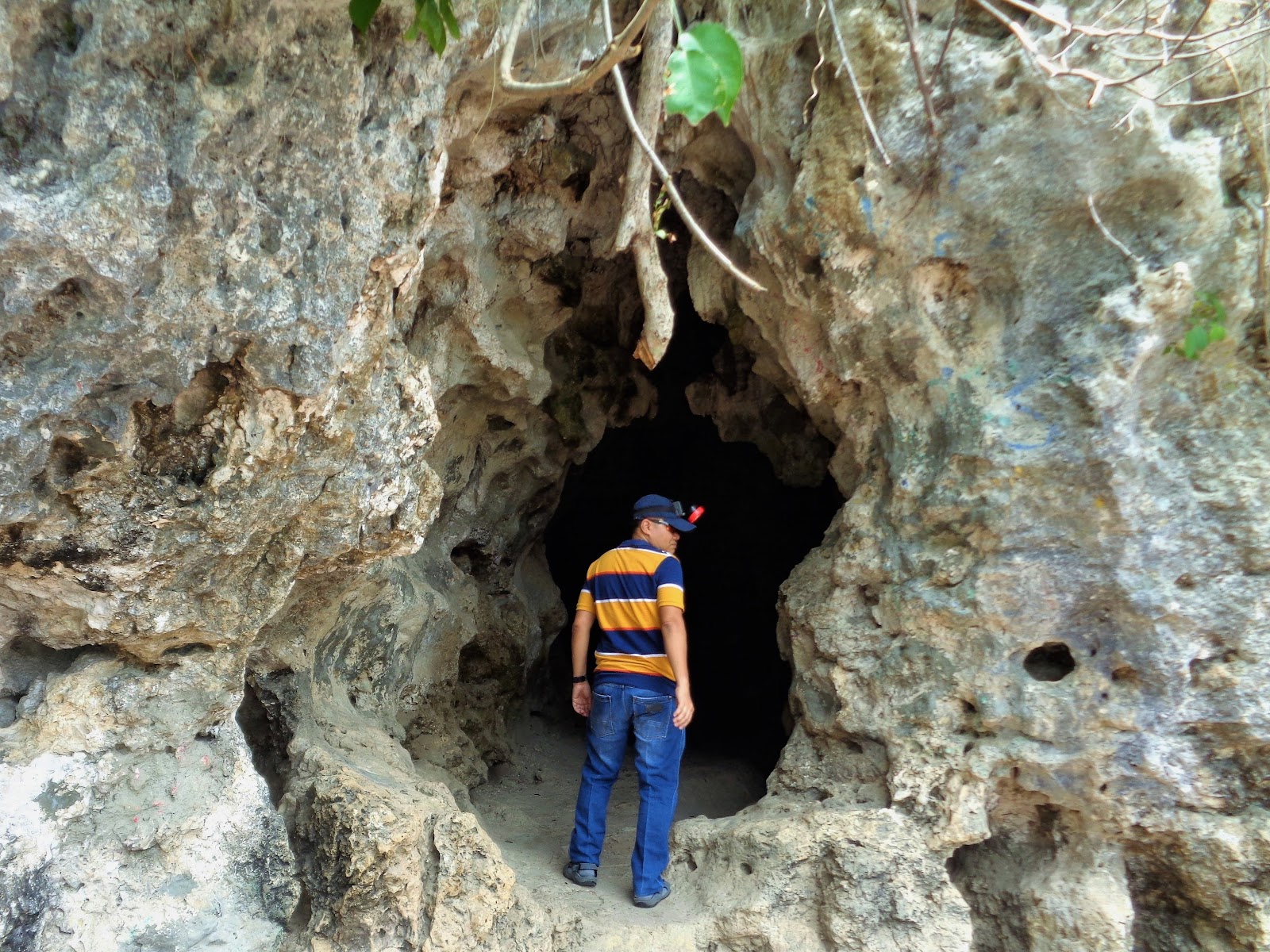
from the souvenirs and trinkets for sale, I noticed several headlights on
display at the stall. I asked the woman
if they were up for grabs, too. “For rent only, sir. Twenty pesos each”, came
the reply. I got one and placed it on my head. In a jiffy, I was ready to
explore the cavern!
 Near
the cave’s entrance are two markers that provide details about Macahambus as
well as its historical significance. Incidentally, I learned from the woman at
the souvenir stall that the ideal time for visiting the cave is usually in the
morning, say, 9 AM onwards. By late afternoon, it is usually off limits to the
public.
Near
the cave’s entrance are two markers that provide details about Macahambus as
well as its historical significance. Incidentally, I learned from the woman at
the souvenir stall that the ideal time for visiting the cave is usually in the
morning, say, 9 AM onwards. By late afternoon, it is usually off limits to the
public. |
| Inside Macahambus Cave |


One
of the markers stated that Macahamabus is a “thru” cave, meaning it can be
entered at one and exited at the other. The cave has three chambers, all of
which served as sanctuary of many Kagay-anon soldiers during the
Philippine-American War.
 |
 Upon entering the first chamber, I readily felt the cool breeze coming from the cave’s opening at its opposite side. Soon it turned dark as I walked deep into the inner recesses of Macahambus with only my headlight and my phone’s flashlight illuminating the path.
 | ||||
Then
I saw a small, cramped opening—quite small that I had to crouch to fit right
into it—that leads into another chamber. After making it through that hole, I
walked several meters more. To my
delight, the path I was treading grew bright as light coming from outside
illuminated the walls of the cave.
|
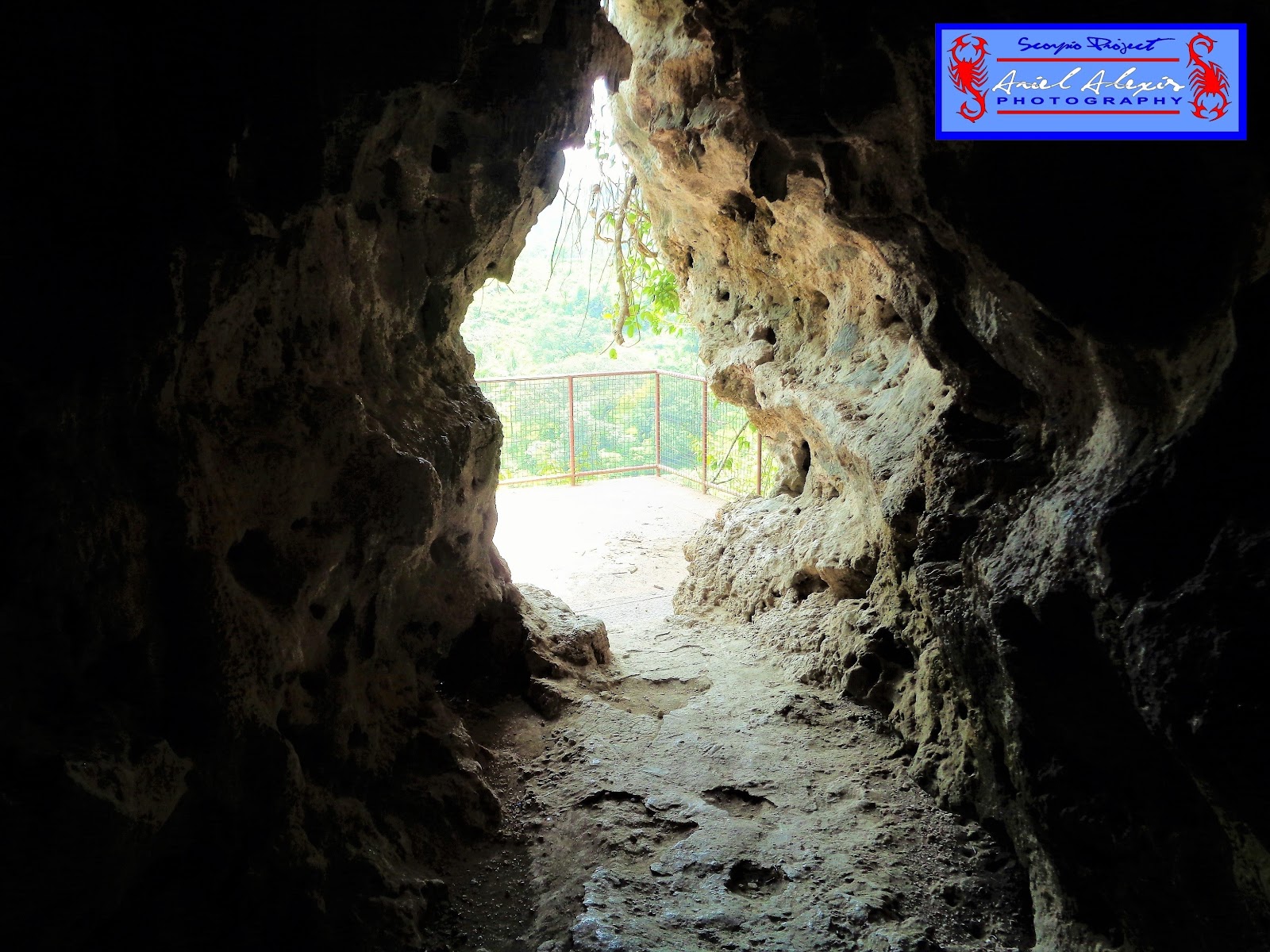 |

Geez,
before I knew it, I had reached the other side of Macahambus Cave! I came out
of the dark chamber and stepped into a steel view deck. Standing there, I was
rewarded with a breathtaking vista of the mighty Cagayan de Oro River (or at
least a part of it), several hundred feet below me. Whew, whatta quickie of an
adventure!
 |
| Hole at the other end of the cave |

 For
visitors who have no vehicle but want to see the cave, they may take any of the
PUVs going to Lumbia, where the old CDO airport is located. Fare is about Php25
per person. A taxi, on the other hand, will cost them around Php400 for a round
trip.
For
visitors who have no vehicle but want to see the cave, they may take any of the
PUVs going to Lumbia, where the old CDO airport is located. Fare is about Php25
per person. A taxi, on the other hand, will cost them around Php400 for a round
trip. | |||
| A portion of the mighty Cagayan de Oro River as seen from the view deck |
 |
| Entrance to Gardens of Malasag Eco-tourism Village |
Highland Gardens

Still
flushed with exhilaration, I hopped into my car and drove towards the village
of Cugman along the Cagayan-Iligan-Butuan Highway. Destination: the Gardens of
Malasag Eco-tourism Village (GMEV). From
what I’ve gathered, GMEV provides visitors with a colorful glimpse of the rich
ethnic heritage of Northern Mindanao as well as its ecology thru various
artifacts, customs and traditions and flora and fauna, put together in one
unique highland resort.
 |
| GMEV's ethnic-inspired dorms |
Neatly
tucked within the verdant slopes of CDO’s Cugman Watershed, GMEV, which was
conceptualized in 1991, is an eco-friendly habitat, which, according to the
brochure I read, was created out of inspiration from the botanical gardens of
Spain and Canada.

Spread
across seven hectares of forestland, GMEV is made up of several botanical plots
with a small wildlife collection of butterflies, birds and deer. Seeing the
highland resort for the first time, it struck me as an ethnic theme park of
sorts whose main come-ons are the tribal houses representing the abodes of the
indigenous cultures found in Northern Mindanao.
The
tribal village represents a microcosm of the life and heritage of the lumads like the Subanon, Talaandig and
Higaonon, to name a few. The houses feature the tribal communities doing
handicrafts, perform rituals, dances and other art forms, their traditional
handicrafts, agricultural implements, ethnic instruments and ornaments.
 |
| Huge forest trees inside GMEV |

GMEV
also boasts of the following amenities: camping ground, swimming pool, function
halls, dormitories, amphitheater, aviary, hanging bridge, souvenir shop,
mini-plaza, flower gardens, to name some.
I
had no idea where GMEV is specifically located. Though I saw the place in
pictures posted in several websites, I wasn’t familiar with the routes in CDO.
Good thing, I managed to locate it using Google® Maps. With the virtual map as
my guide, I was able to reach it.
 For
visitors who have no vehicle but wish to see GMEV, they can take any of the
PUVs passing by Cugman. At the waiting shed along the highway, motorcycles for
hire await passengers bound for Malasag Hill. Fare is about Php25 per person. A
taxi will compel guests to shell out around Php300 for a two-way trip.
For
visitors who have no vehicle but wish to see GMEV, they can take any of the
PUVs passing by Cugman. At the waiting shed along the highway, motorcycles for
hire await passengers bound for Malasag Hill. Fare is about Php25 per person. A
taxi will compel guests to shell out around Php300 for a two-way trip.  A
slight drizzle welcomed me as I negotiated my way through a narrow but
well-paved road that leads to the highland hideaway. Though it hardly dampened
my spirit, the light rain made the road slippery so I had to drive at low speed
to avoid any untoward incident as I went up the hill.
A
slight drizzle welcomed me as I negotiated my way through a narrow but
well-paved road that leads to the highland hideaway. Though it hardly dampened
my spirit, the light rain made the road slippery so I had to drive at low speed
to avoid any untoward incident as I went up the hill. |
| Walkway inside GMEV |

 Minutes
later, I saw the sign pointing to my destination. Pulling over, I headed for
the information counter and paid the entrance fee (Php50). Afterwards, I proceeded
with my photo walk around GMEV.
Minutes
later, I saw the sign pointing to my destination. Pulling over, I headed for
the information counter and paid the entrance fee (Php50). Afterwards, I proceeded
with my photo walk around GMEV.
All
of a sudden, it started raining cats and dogs, forcing me to abort the tour and
seek refuge in a resto-café within the GMEV premises. I ordered some pica-pica
while waiting for the rain to stop.
 |
| Hazy view of CDO and Macalajar Bay |
 Sitting there, I was treated to a breathtaking seascape of CDO and Macalajar Bay below, albeit nebulous because of the haze. On a clear day, I bet it would be an awe-inspiring vista worth a dozen clicks.
By
5 o’clock, the drizzle still showed no signs of waning. So, before darkness
could creep into the resort, I decided to drive my way back to the downtown
area.
 Thinking
about going somewhere where you can be carefree and cheery? A happy place
bursting with so much dynamism and energy that will make you smile like you
haven’t smiled before. No problemo, mi
amigo. Just go to CDO pronto.
When you get there, I’m certain you’ll find something to make you exclaim:
“Hakuna Matata!” 🤣
Thinking
about going somewhere where you can be carefree and cheery? A happy place
bursting with so much dynamism and energy that will make you smile like you
haven’t smiled before. No problemo, mi
amigo. Just go to CDO pronto.
When you get there, I’m certain you’ll find something to make you exclaim:
“Hakuna Matata!” 🤣