Known here and abroad as one of the Philippines’ major
tourist destinations, the island province of Cebu is home to numerous Spanish
colonial churches that were built during Spain’s 333 years of sovereign rule in
the archipelago.
Known here and abroad as one of the Philippines’ major
tourist destinations, the island province of Cebu is home to numerous Spanish
colonial churches that were built during Spain’s 333 years of sovereign rule in
the archipelago.
 Many of these heritage churches, resplendent even to this
day with their unique fusion of European and Asian architecture, dot various
parts of the province’s landscape and continue to portray a crucial role in the
spiritual development of today’s generation of Cebuanos.
Many of these heritage churches, resplendent even to this
day with their unique fusion of European and Asian architecture, dot various
parts of the province’s landscape and continue to portray a crucial role in the
spiritual development of today’s generation of Cebuanos.
 Whenever I’m lost and languishing, I gravitate towards
the province, lingering in its premier city, which, through the years, has
served as some sort of spiritual oasis for me given the treasure-trove of
houses of worship there that I revisit every now and then.
Whenever I’m lost and languishing, I gravitate towards
the province, lingering in its premier city, which, through the years, has
served as some sort of spiritual oasis for me given the treasure-trove of
houses of worship there that I revisit every now and then.
 |
Archdiocesan Shrine of St. Michael the Archangel
|
Recently, I had a rare chance of seeing for the first
time some of the most awesome churches
found in Cebu’s southern towns. Hopping into them was my Plan B, which I
pursued when a planned trip to a nearby group of islands went kaput.
It was a last-minute change that I embraced
enthusiastically as I‘d been looking forward to visiting some of the oldest
bastions of Christianity not only in the Visayas but in the whole country as
well. Also, I wanted to see for myself what’s with these churches that have
made them part and parcel of our national patrimony.
 Embarking on a visita
iglesia long after Lent had passed seems out-of-sync, if not, incongruous
for a last summer hurrah. Still, I opted for it because I’ve been yearning for
a soul-enriching trip that would feed my faith as the wave of escapades
I’ve had lately catered only to my mundane cravings.
Embarking on a visita
iglesia long after Lent had passed seems out-of-sync, if not, incongruous
for a last summer hurrah. Still, I opted for it because I’ve been yearning for
a soul-enriching trip that would feed my faith as the wave of escapades
I’ve had lately catered only to my mundane cravings.
 |
Dr. Jose Rizal's monument at the town plaza
|
To my delight, the spiritual sojourn to that part of the
island province had me captivated, cleansed and consummated as a pilgrim of
sorts after paying a visit to the churches of Argao, Boljoon, Carcar, Dalaguete
and Oslob.
These four southern towns, as well as Carcar City, have
houses of worship—all survivors of the 2013 killer quake that hit Bohol and
many parts of Cebu—that are reputed to be among the province’s finest, some of
which are historical landmarks and/or cultural treasures.

 Let me take you now to an armchair tour of Cebu’s
magnificent churches in the south, which I’ll present alphabetically, starting
with Argao.
Let me take you now to an armchair tour of Cebu’s
magnificent churches in the south, which I’ll present alphabetically, starting
with Argao.
Better known for its fine white-sand beaches, Argao was
founded as a pueblo in 1608. Since
then, it has grown from a sleepy fishing community to one of Cebu’s top tourist
magnets at present.
 |
This old infantry barracks now houses Argao's Hall of Justice
|
I’ve always wanted to explore the place after I’ve first
read about its numerous heritage attractions in a travel magazine. Since then,
Argao has been in my thoughts whenever I visit Cebu. Plans to go on a heritage
tour there, however, had to be aborted several times in the past due to time
and resource constraints.
 Seen finally for the first time, I was burning with
excitement as I explored the town, which, according to legend, was named after
a species of trees that the locals call sali-argaw,
a highly medicinal herb growing in abundance there. The trees were also said to
be a favorite resting place of fisher folks upon their return from the sea.
Seen finally for the first time, I was burning with
excitement as I explored the town, which, according to legend, was named after
a species of trees that the locals call sali-argaw,
a highly medicinal herb growing in abundance there. The trees were also said to
be a favorite resting place of fisher folks upon their return from the sea.
 The two-hour commute to Argao provides travellers with
breathtaking glimpses of rugged cliffs, low-lying hills, sprawling fish ponds,
new subdivisions and the elongated shoreline and blue waters of Bohol Strait as
the bus meanders through Cebu’s southern coastal road, some portions of which
are under repair.
The two-hour commute to Argao provides travellers with
breathtaking glimpses of rugged cliffs, low-lying hills, sprawling fish ponds,
new subdivisions and the elongated shoreline and blue waters of Bohol Strait as
the bus meanders through Cebu’s southern coastal road, some portions of which
are under repair.
 For this gadabout, the visit to the beach town turned out
to be one rewarding and inspiring experience than he’s ever imagined it to be,
made exciting by the myriad discoveries of Argao’s historical and cultural
treasures that are, for the most part, unknown to him before.
For this gadabout, the visit to the beach town turned out
to be one rewarding and inspiring experience than he’s ever imagined it to be,
made exciting by the myriad discoveries of Argao’s historical and cultural
treasures that are, for the most part, unknown to him before.
 |
Casa Real
|
Not too many travellers (that used to include me!) know
that Argao has a cultural ace up on its sleeve—the awe-inspiring St. Michael
the Archangel (San Miguel Arcangel) Church. Named after the town’s patron
saint, the house of worship was built around 1734 and completed in 1788.
 Located a few blocks away from the national highway,
neatly tucked within a maze of concrete interior roads, this stunning 226-year
old church, which faces Bohol Strait is often missed by those visiting the
beach town.
Located a few blocks away from the national highway,
neatly tucked within a maze of concrete interior roads, this stunning 226-year
old church, which faces Bohol Strait is often missed by those visiting the
beach town.
Thanks to Google® Maps and the friendly trisikad driver who took me there, I
effortlessly found my way into the ancient church, which, I learned later, has
been elevated into an archdiocesan shrine of one of the most popular
archangels.
 |
| Facade of the Argao Church |
Once a part of a walled pueblo known as Cabecera de Argao, St. Michael the Archangel Church
is surrounded with a short concrete fence that has reliefs of the Stations of
the Cross. Inside this former Spanish enclave are a
plaza, a municipal hall and a courthouse. A recent addition is a modern-day
structure that serves as the legislative hall.
 |
| The church's pediment |
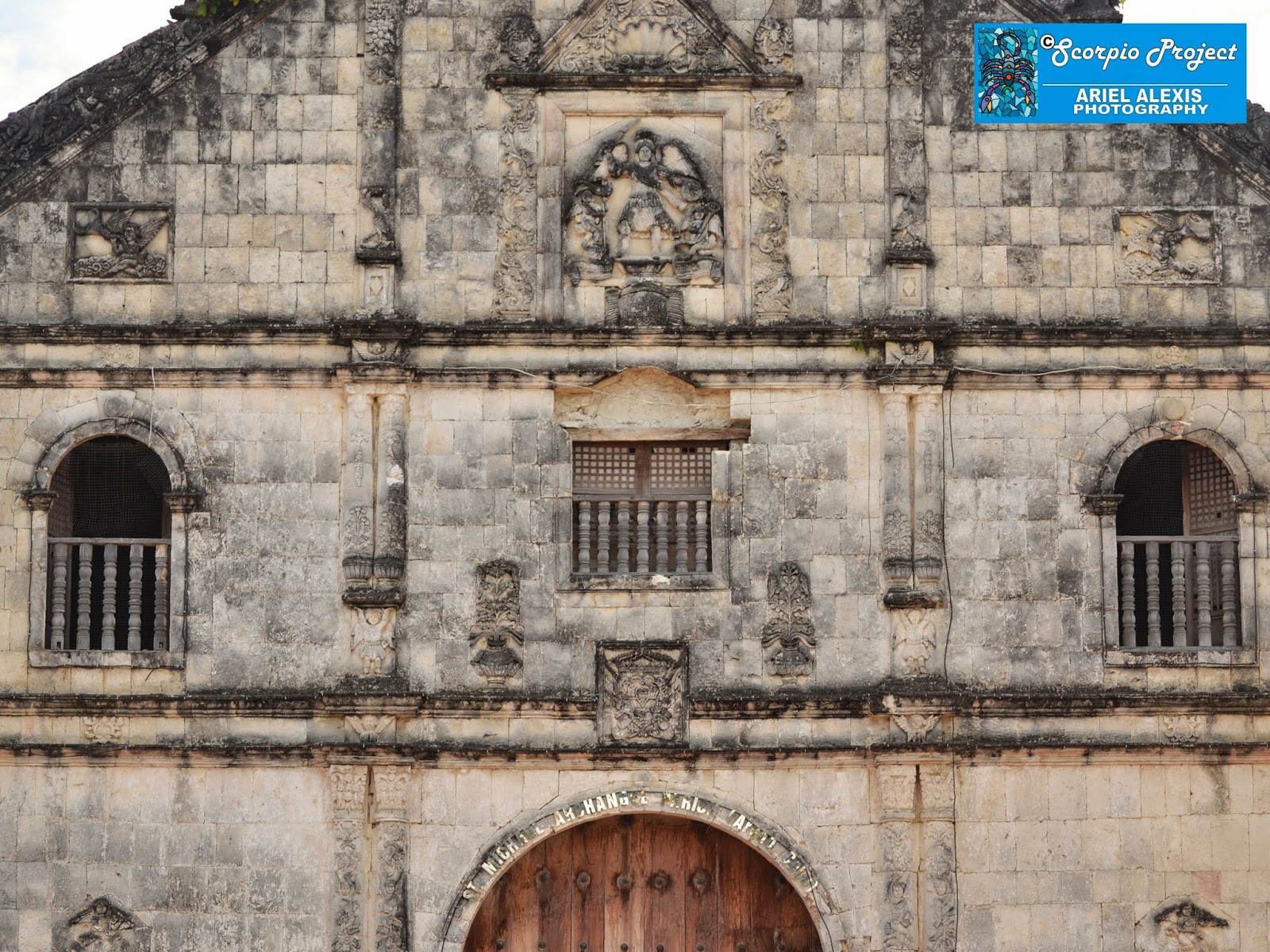
It was, however, the town’s magnificent heritage church
that captured my attention. Shaped like a horizontal rectangle, its simple
façade, topped by a triangular pediment, provides visitors nary a trace of the
monumental treasures found inside it.
 |
Niched bas-relief of St. Michael at the pediment
|
 Divided into three panels, the façade has four pairs of
twin columns stretching all the way to the pediment. Bearing Chinese
influences, the two outer columns feature pedestals carved with sitting lions,
each holding a ball on their paws.
Divided into three panels, the façade has four pairs of
twin columns stretching all the way to the pediment. Bearing Chinese
influences, the two outer columns feature pedestals carved with sitting lions,
each holding a ball on their paws.
At the center of the pediment is a bas-relief of the
patron saint, armed with spear and shield, and flanked by two angels blowing
their trumpets. On each side of this relief are oversized urn-like finials
rising on rectangular bases at each corner of the pediment.
At the lower end of the church’s frontage is a huge
wooden entrance. For reasons only the locals know, two iron screen doors, which
I found abominable and discordant with the church’s old world allure, are
attached to the main door. I have my thoughts about this but I’d rather keep them
to myself. LOL!
 Exploring the interior of the Argao Church, I was overwhelmed with the
wide array of treasures I saw there—magnificent ceiling paintings, an exquisite
main retablo, an ancient pulpit, a
wooden organ, among others—that would surely delight the senses of heritage
lovers.
Exploring the interior of the Argao Church, I was overwhelmed with the
wide array of treasures I saw there—magnificent ceiling paintings, an exquisite
main retablo, an ancient pulpit, a
wooden organ, among others—that would surely delight the senses of heritage
lovers.
 Five retablos
adorn the church’s interior. But it was the stunning gold-painted (?) main retablo, exemplifying the architectural
style called Rococo-Baroque, which awed me when I got inside the church and
headed towards the sanctuary.
Five retablos
adorn the church’s interior. But it was the stunning gold-painted (?) main retablo, exemplifying the architectural
style called Rococo-Baroque, which awed me when I got inside the church and
headed towards the sanctuary.
Made up of four niches, the central retablo contains gilded statues of the three archangels at the
lower level: St. Raphael (left), St. Gabriel (right) and St. Michael (center).
At the top center stands a sculptor of the Virgin Mary, also painted in gold.
 |
The church's Rococo-Baroque main retablo
|
As typified by Argao’s church, Rococo architecture makes
use of a more flamboyant, jovial and rhythmic approach compared to traditional
Baroque, highlighted by light colors, ornate curves and lots of gold.

 The church’s vaulted ceiling is made of wooden panels
arranged longitudinally with cherubs overhanging as corbels. Adorning the
ceiling are murals of the angels and archangels, said to have been done by
Canuto Avila and Ray Francia, two of the best Visayan church muralists during
the 1920s and 1930s.
The church’s vaulted ceiling is made of wooden panels
arranged longitudinally with cherubs overhanging as corbels. Adorning the
ceiling are murals of the angels and archangels, said to have been done by
Canuto Avila and Ray Francia, two of the best Visayan church muralists during
the 1920s and 1930s.
 Hanging prominently on the right side of the church’s
nave is a wooden pulpit with a dome-shaped canopy. Sculpted on it are the
painted bas-reliefs of the four Gospel evangelists—St. Luke, St. Mark, St.
John, St. Matthew—and the Virgin Mary.
Hanging prominently on the right side of the church’s
nave is a wooden pulpit with a dome-shaped canopy. Sculpted on it are the
painted bas-reliefs of the four Gospel evangelists—St. Luke, St. Mark, St.
John, St. Matthew—and the Virgin Mary.
 I also noticed a wooden pipe organ hanging on the right
side of the church near the choir loft. I’m not so sure though if it’s still
working. But I read somewhere it came all the way from Mexico.
I also noticed a wooden pipe organ hanging on the right
side of the church near the choir loft. I’m not so sure though if it’s still
working. But I read somewhere it came all the way from Mexico.
Overall, St. Michael the Archangel Church stands out as
one of the most spectacular ancient houses of prayer I’ve ever seen in the
island province. I’m just wondering though why it hasn’t been declared a
National Cultural Treasure. Maybe it’s
forthcoming. :-D
(to be continued)
In coming up with
this anthology on Cebu’s heritage churches, I’ve referred to the following:


 Divided into three panels, the façade has four pairs of
twin columns stretching all the way to the pediment. Bearing Chinese
influences, the two outer columns feature pedestals carved with sitting lions,
each holding a ball on their paws.
Divided into three panels, the façade has four pairs of
twin columns stretching all the way to the pediment. Bearing Chinese
influences, the two outer columns feature pedestals carved with sitting lions,
each holding a ball on their paws.